Choose Funchal Old Town if you want historic streets, restaurants and city sightseeing close to your accommodation. Choose Lido if swimming, a hotel pool and time beside the sea matter more. Both can work without a rental car, but they suit different daily routines.
The decision is less about which neighbourhood is “better” and more about where you want to spend your unplanned hours. Old Town makes it easy to step outside and wander. Lido makes a slower afternoon by the water easier to arrange.
This comparison focuses on those two areas. For other neighbourhoods and the broader choice of accommodation, see our guide to where to stay in Funchal.
Funchal Old Town vs Lido: The Main Differences
| Priority | Old Town | Lido |
|---|---|---|
| Best fit | A city stay built around walking, dining and sightseeing | A hotel stay built around swimming, sea views and relaxation |
| Surroundings | Narrow historic streets and a compact restaurant district | A more spread out hotel area with a coastal promenade |
| Evenings | Convenient for dinner and bars around Rua de Santa Maria | Convenient for dinner near your hotel and waterfront walks |
| Swimming | Possible nearby, but check the accommodation’s own facilities | A stronger starting point for a swimming focused holiday |
| Main booking concern | Street noise, stairs and the exact building location | Distance from central Funchal and the slope to the waterfront |
These are starting points rather than rules. A quiet Old Town hotel with a pool may suit you better than a roadside Lido apartment. Compare actual properties after choosing your preferred area, not before.
Where Are Old Town and Lido?
Funchal Old Town, or Zona Velha, sits on the eastern side of the central waterfront around Rua de Santa Maria. Lido lies west of the centre, around the bathing complex and the hotel district associated with Estrada Monumental. They belong to the same city, but they are not neighbouring blocks. The official Funchal street map helps put the two areas in context.
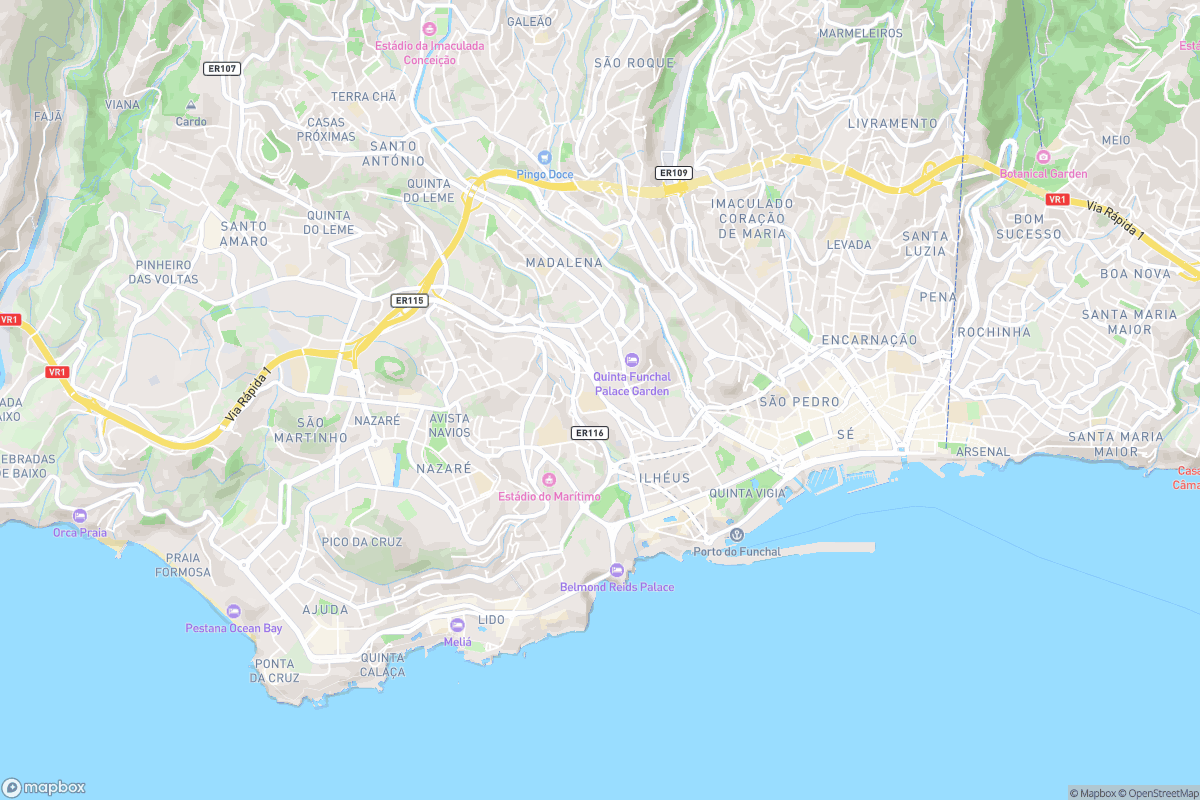
“Central Funchal” and “Old Town” are not interchangeable labels. A property near the cathedral may be central without being in Zona Velha. Likewise, accommodation advertised as Lido can sit farther west or uphill from the waterfront.
For planning, allow roughly an hour on foot between Old Town and the central Lido area. Treat that as an estimate: your accommodation, route and walking pace can change it considerably. Do not assume the journey follows a flat promenade throughout.
Before booking, map three routes from the property entrance: to dinner, to your likely transport stop and to the waterfront. Those routes tell you more than a neighbourhood label.
Staying in Funchal Old Town
Old Town suits travellers who want their accommodation to feel part of the city rather than a destination in itself. Its narrow cobbled streets, older façades and painted doors give a short walk something to look at. Restaurants and bars also make this an evening district, not just somewhere to visit during the day. The tourism board’s overview of Funchal Old Town covers that combination of heritage and nightlife.
The practical advantage is spontaneity. You can leave your room for coffee, return after sightseeing and head out again for dinner without treating each outing as a separate transport decision. That matters on a short stay, when repeated journeys across the city can eat into your available time.
A couple spending three nights in Funchal with no plans to use a hotel pool would have good reason to favour Old Town. A traveller who wants several hours of swimming each afternoon would have less reason to prioritise it.
What to Check Before Booking in Old Town
Pay close attention to the bedroom’s position. A room facing a busy restaurant street offers a different night from one facing an internal courtyard. Read recent reviews for comments about voices, music, deliveries and window insulation rather than relying on a general description such as “lively location”.
Check stairs and lift access too, especially in a converted building. Photographs of an attractive entrance do not establish whether you can reach the room comfortably with luggage.
Our Old Town walking guide covers the neighbourhood’s sights in more detail. For choosing accommodation, the more useful question is whether you want those streets outside your door every evening.
Staying in Lido
Lido is the stronger starting point when the hotel forms a large part of the holiday. Begin your accommodation search here if your priorities include a pool, a balcony and easy access to the waterfront. Still check every amenity at property level: a Lido address does not automatically include sea access, a heated pool or an unobstructed view.
The coastal setting is a genuine reason to choose this side of Funchal. The Funchal seaside promenade runs through the western waterfront, passing gardens and bathing areas around Ponta Gorda and Ponta da Cruz. It gives a stay here a different rhythm from walking the historic centre.
Lido makes sense for a week that mixes island outings with days spent near the accommodation. You can make a deliberate trip into Old Town rather than arranging every day around central sightseeing.
What to Check Before Booking in Lido
Look beyond the sea view. Establish whether the property sits above or below Estrada Monumental, how you reach the promenade and whether the return involves steps or a steep climb. An ocean view does not flatten a hill.
Ask what “pool access” includes. Check the pool’s location, operating arrangements, heating if advertised, and whether children can use it. For a winter stay, confirm those details for your travel dates rather than relying on summer photographs.
Room position matters here too. Compare exposure to road traffic, neighbouring venues and hotel entertainment before assuming Lido will be quieter.
Which Area Is Better for Swimming?
Lido is the better default if swimming is a daily priority. The Lido bathing complex has seawater pools, including a children’s pool, and access to the ocean. Old Town is not cut off from swimming: Barreirinha, near Forte de São Tiago, provides direct sea access and a sunbathing area. Both appear in the regional tourism authority’s guide to Funchal’s bathing areas.
The distinction is between having somewhere to swim nearby and choosing accommodation organised around swimming. If you want to move repeatedly between your room, a pool and a sun lounger, prioritise the hotel’s own facilities. A public bathing complex is a separate outing, with its own admission arrangements and opening hours.
Neither neighbourhood should be booked on the assumption of a broad sandy beach outside the door. Check photographs of the actual water access, not just photographs looking out to sea.
Ocean access also depends on conditions. Check current opening information, follow local restrictions and keep a pool or another activity in reserve rather than making a sea swim the day’s only plan.
Restaurants, Evenings and Sleeping Well
Old Town has the advantage if your preferred evening involves wandering around the historic restaurant streets, choosing dinner and walking back afterwards. Staying nearby removes the temptation to turn every meal into a calculation about the journey home.
Lido works better if you want most evenings to remain close to the hotel. There is no need to cross Funchal for every dinner, and an occasional Old Town evening can remain part of the trip.
Do not use either neighbourhood as a guarantee of food quality. Compare menus, prices and recent reviews restaurant by restaurant. A historic address does not improve a meal, just as a hotel district does not rule out a good one.
For sleep, the building and room usually deserve more attention than the area’s reputation. Ask whether bedrooms face a road, restaurant terrace or entertainment space. If you are sensitive to noise, request a quieter room before paying for a nonrefundable booking.
Getting Around Without a Car
Either area can work for a stay without a car, but separate three needs: travelling around Funchal, reaching the airport and getting to places elsewhere on Madeira. An accommodation choice that suits one does not automatically solve the other two.
For the airport, the published Aerobus route includes Mercado and Avenida do Mar in central Funchal, followed by stops along Estrada Monumental and at Lido. Check the official SIGA Aerobus route and timetable against your arrival time and property address. The final walk with luggage may matter more than a small difference in bus journey time.
For daily travel, map the stop you would actually use and check the return service as carefully as the outward one. A bus connection is useful only if it fits the hours you intend to keep. Our guide to Madeira’s buses and trip planning covers that process.
For organised excursions, confirm the pickup point before booking accommodation. Do not assume collection from every hotel or apartment. Likewise, check the departure location for any boat trip rather than treating the whole waterfront as one meeting point.
Hills, Accessibility and Rental Cars
Neither Old Town nor Lido is automatically the right choice for reduced mobility. Old Town’s paving and narrow streets deserve attention; in Lido, the connection between the hotel, road and waterfront deserves equal scrutiny.
Ask the accommodation for practical details: steps at the entrance, lift dimensions where relevant, bathroom access and the easiest route to nearby restaurants. “Accessible location” is too vague to settle a booking decision.
If you are renting a car, compare parking arrangements before comparing room rates. Ask whether a space is guaranteed, whether it costs extra, and how far it is from reception. For an apartment, establish the unloading point and whether the parking belongs to the property or is a separate public facility.
A larger hotel may offer convenient parking, but do not assume that from the building’s size. Equally, an Old Town stay can work with a car if you are comfortable parking separately and walking to the accommodation.
Which Area Offers Better Value?
There is no dependable rule that Old Town is cheaper or Lido is better value. Compare properties for the same dates, occupancy and cancellation terms, then add the costs created by their location.
An apartment with cooking facilities may suit a longer stay. A hotel with breakfast and a pool may justify a higher room price if you will use both. Paying for facilities you leave behind every morning is less persuasive.
Consider a hypothetical seven night stay where one property costs €20 less per night. That saves €140 before transport, parking or meals. The cheaper room remains the better deal only if its compromises are worth accepting.
Count time too. If most of your plans are in central Funchal, repeated travel from Lido may outweigh a modest saving. If most afternoons belong to the pool, paying extra to stay in Old Town may achieve very little.
Which Should You Book?
Book Old Town for a short, city focused stay. It is the more practical choice when historic streets, central sightseeing and dinners around Rua de Santa Maria form the core of your plans. Choose the room carefully if you want early nights.
Book Lido for a hotel and swimming focused stay. It is the better starting point when the pool, waterfront and accommodation deserve as much time as sightseeing. Check the slope, room position and journey into the centre before committing.
If you remain undecided, write down where you expect to be at breakfast, mid afternoon and after dinner. Choose the area that makes those ordinary moments easier. You can visit the other neighbourhood without moving hotels.