Investing in Madeira can mean buying property, acquiring an interest in a local business or purchasing shares in a Portuguese company with operations in the region. It can also mean managing an international investment portfolio while living on the islands. These activities create different sources of income, ownership rights and financial risks.
The distinction matters because an investment connected to Madeira does not necessarily depend heavily on Madeira’s economy. A Portuguese retailer might operate supermarkets in Funchal while earning most of its revenue elsewhere. A company registered in Madeira might serve customers abroad. A holiday apartment, by comparison, depends much more directly on conditions in its immediate location.
For stock-market investors, the practical route into Portuguese listed companies is through a broker offering access to shares listed on Euronext Lisbon. The relevant questions are which company the investor will own, how much of its business relates to Madeira and whether the broker supplies actual shares.
Property and private businesses require a different process. Their value depends on asset-specific income, financing, operating costs and the terms under which ownership can eventually be transferred. A favourable view of Madeira provides a starting point for research, but it does not establish an acceptable purchase price.
What Kind of Madeira Investment Are You Buying?
Direct exposure to the local economy
Direct investment usually involves an asset whose income is generated substantially within Madeira. An apartment rented to residents, a guesthouse serving visitors or a business supplying local customers has an identifiable connection to regional demand.
Even within this category, the underlying economics differ. A residential landlord depends on tenants’ ability to pay, the property’s condition and the terms of the tenancy. An accommodation operator depends on bookings, pricing, distribution costs and service quality. A supplier serving hotels may depend on a relatively small number of commercial customers.
The investment analysis should therefore begin with the source of cash receipts. The location of an asset is less informative than an explanation of who pays for its services, why they continue paying and what costs must be incurred to retain that business.
Direct ownership can provide substantial control, but exercising that control requires work. An investor who appoints a manager still needs to assess performance, approve expenditure and monitor whether reported results match cash received.
Listed shares and indirect exposure
Listed equities provide ownership in a company through a security that can be traded through a brokerage account. They can offer a practical way to invest smaller amounts and spread capital across several businesses.
However, ownership is at the level of the listed company. Buying shares in a group with Madeira operations does not give the shareholder a separate claim on its local stores, hotels or other regional assets. Returns depend on the wider group and the price paid for its shares.
An investor living in Madeira can also hold assets with little connection to the region. That may be relevant when employment income, a home and business interests already depend on the same local economy.
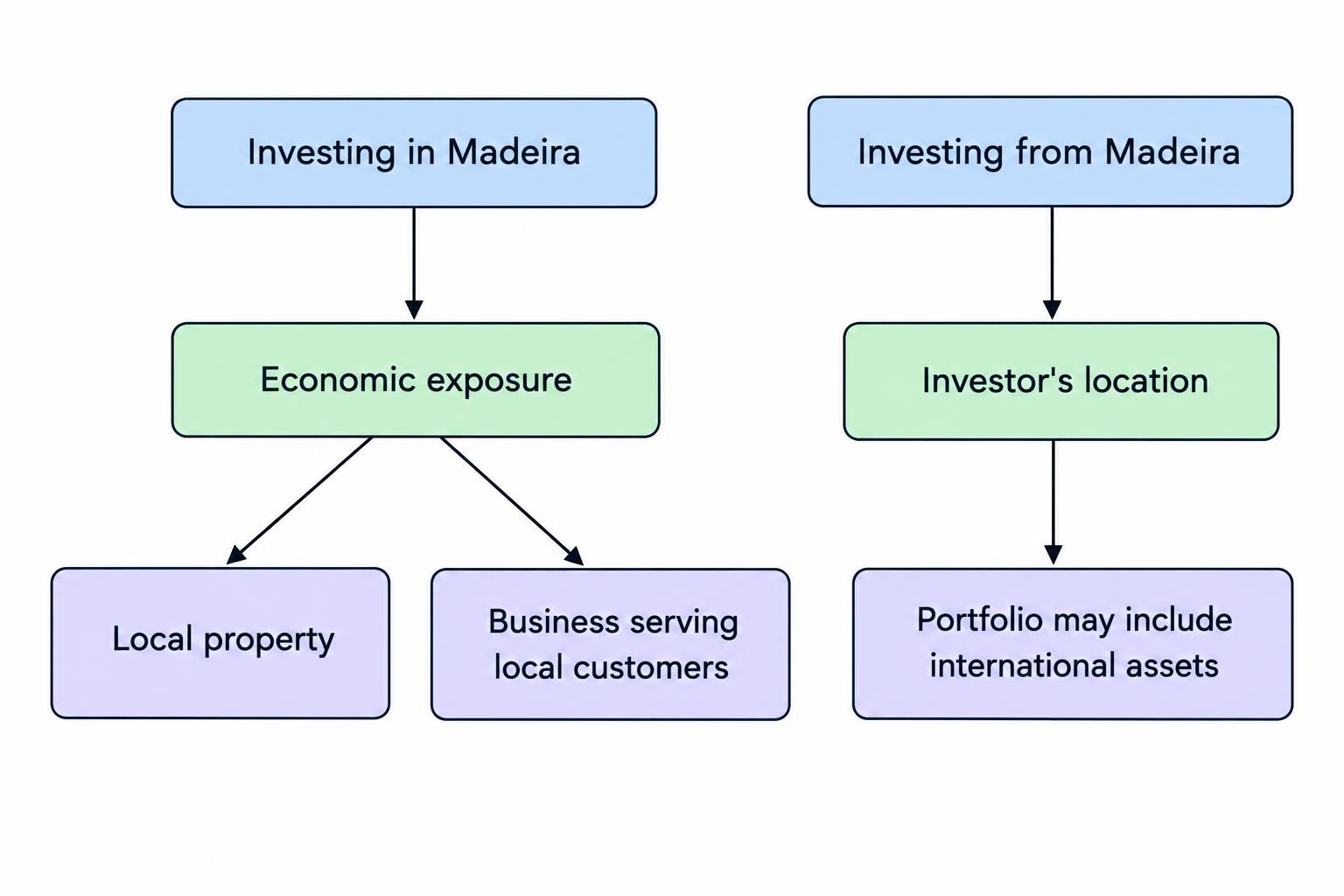
The useful distinction is between investing in Madeira and investing from Madeira. The former describes economic exposure. The latter describes the investor’s location. Keeping those concepts separate helps prevent an unnecessarily concentrated portfolio.
Assessing Madeira’s Economy Before Investing
Tourism demand and business profitability
Tourism provides an important source of demand for accommodation and related services. Madeira’s Regional Directorate of Statistics reported more than 12.9 million overnight stays across the broad accommodation categories covered by its final 2025 tourism statistics, an increase of 7.9% from 2024. Within collective tourist accommodation, residents abroad accounted for 83.8% of overnight stays. These figures are available in the DREM tourism releases.
Those figures support the existence of substantial visitor demand. They do not establish the profitability of a particular investment. An increase in overnight stays may be accompanied by additional accommodation supply, higher wages, larger maintenance bills or increased spending on customer acquisition.
For an accommodation business, occupancy and the average price achieved need to be examined together. Filling more rooms at a substantial discount can produce less profit than operating at lower occupancy with stronger prices. Revenue growth can also conceal weakening margins if operating costs rise faster.
An investor should examine monthly results across several years where records are available. Annual totals can obscure periods when a business consumes cash, depends on advance bookings or postpones maintenance to preserve liquidity.
Local demand, competition and operating costs
Businesses serving residents require a separate assessment from those primarily serving visitors. A product that sells well to tourists may attract limited repeat demand from local households. A business built around regular local customers may have more predictable transactions but less scope to charge premium prices.
Competition should be assessed at the level of the relevant customer market. Regional growth does not prevent an individual neighbourhood from becoming oversupplied with similar accommodation or services. A new competitor can affect pricing even when total visitor numbers continue increasing.
Operating forecasts should use actual supplier quotations wherever possible. Delivery arrangements, stockholding requirements, equipment servicing and replacement lead times can affect the amount of working capital required. These expenses are easy to underestimate when a forecast begins with mainland cost assumptions.
For a business dependent on international visitors, it is also useful to test weaker demand from its principal source markets. The purpose is to establish how much revenue could fall before the business needs additional funding. A forecast becomes more useful when it identifies the conditions under which the investment would fail to meet its financial obligations.
Portuguese Stocks and Their Connection to Madeira
Understanding what “Madeira stocks” means
The expression “Madeira stocks” needs a company-specific definition. It might refer to a company founded in Madeira, a Portuguese listed group operating there or a private company registered in the region. These are different forms of ownership, and only some will be available through an ordinary stockbroking account.
For Portuguese listed equities, Euronext Lisbon provides the relevant market infrastructure. Its principal benchmark, the PSI, is weighted by free-float market capitalisation and represents actively traded shares listed in Lisbon. As Euronext explains, it is an indicator of the Portuguese stock market. It does not measure Madeira’s economy.
A company’s registered address also needs to be distinguished from the location of its customers and assets. Corporate domicile can affect legal and tax arrangements, while business performance may depend primarily on activity in other countries.
The financial statements should establish the relationship between the company and the region. An investor looking for Madeira exposure needs evidence of regional sales, assets or profits. Where the company does not disclose those figures separately, the scale of that exposure may remain uncertain.
Jerónimo Martins as an example
Jerónimo Martins illustrates the difference between a local operating presence and the economics of a listed group. Its Pingo Doce business operates across mainland Portugal, the Azores and Madeira, as described on the company’s Pingo Doce business page.
Shares in the parent company are listed on Euronext Lisbon under the ISIN PTJMT0AE0001. The exchange’s Jerónimo Martins security page identifies the listed instrument.
The group’s 2025 reporting shows that Biedronka accounted for 70.4% of consolidated sales, compared with 14.8% for Pingo Doce. These figures appear in its 2025 annual report. Since Pingo Doce itself operates beyond Madeira, the group’s revenue mix indicates that buying Jerónimo Martins shares provides much broader exposure than a view on Madeira’s consumer spending.
This is an example of how to investigate a connection, rather than a valuation assessment of the shares. Local familiarity with a brand can help an investor understand its customer proposition. It cannot establish whether the parent company’s current share price offers an attractive return.
Evaluating the whole company
Once a potential investment has been identified, the analysis should cover the consolidated business. Revenue growth matters alongside operating margins, debt, capital expenditure and the amount of cash available after maintaining the company’s assets.
A business can report accounting profits while generating limited cash for shareholders. Expansion may require substantial spending, customers may pay slowly or inventories may absorb additional capital. Those factors can reduce the cash available for dividends or debt repayment.
Dividend yield also requires context. A high yield can result from a falling share price and may reflect expectations of a dividend reduction. The relevant question is whether recurring cash generation supports the distribution.
For a company with operations in several countries, currency movements, local competition and financing conditions elsewhere can outweigh developments in Madeira. The investment case should reflect that wider exposure.
Finding a Stockbroker to Invest in Portuguese Shares
Confirm access to the intended security
The first requirement is access to the exact shares under consideration. A broker advertising European markets may offer only selected exchanges or a limited range of securities. Access to one Euronext market does not automatically establish access to every Lisbon-listed company.
Broker comparison services such as BrokerListings can provide an initial overview of platforms and account features. For Portuguese stock investing, the decisive checks remain whether the broker accepts residents of the investor’s country, supports the intended security and offers the required form of ownership.
Using the company’s ISIN helps reduce ambiguity. Company names can be abbreviated differently across platforms, and the same underlying business may appear through several products. The order screen and instrument documentation should identify what will actually be purchased.
Account eligibility should be checked before transferring funds. A broker may serve clients in one jurisdiction through an entity with a different product range from the entity serving clients elsewhere. A global website’s advertised features may therefore differ from those available in the investor’s account.
Distinguish shares from derivatives
A cash-share purchase and a contract for difference are different investments. A CFD provides contractual exposure to price movements without ownership of the underlying shares. Financing charges, margin requirements and the broker’s contractual terms can materially affect the result.
For an investor intending to hold Portuguese equities over several years, that distinction should be resolved before assessing commissions. A low advertised dealing charge has limited relevance if the product carries ongoing financing costs or does not provide the ownership rights the investor expects.
Fractional positions also require examination. Their legal structure, transferability and treatment of shareholder rights can vary between providers. An investor should understand whether a fractional holding can be transferred to another broker or must first be sold.
The account agreement should also explain how corporate actions are handled. Rights issues, takeover offers and other events may require instructions within deadlines. A platform suitable for frequent trading may provide a different level of support from a broker focused on long-term securities custody.
Verify the brokerage entity and custody arrangements
The legal entity opening the account should match the entity identified in the relevant regulatory records. Portugal’s official service for consulting information about financial intermediaries provides access to CMVM information for this purpose.
The review should cover the services the entity is permitted to provide and the jurisdiction under which the account operates. A familiar group name alone does not resolve those questions.
Custody terms deserve separate attention. The investor should understand who holds the securities, how ownership is recorded and what procedure applies when transferring holdings. Where securities lending is offered, the agreement should explain consent, compensation and the consequences for shareholder rights.
Protection arrangements must be read according to their scope. A mechanism addressing an intermediary’s failure to return eligible assets should not be treated as protection against a company’s share price falling.
Compare total costs and execution
The relevant cost is the cost of operating the intended portfolio. Trading commissions are only one component. Custody charges, currency conversion, dividend processing, market-data subscriptions and transfer fees may also matter.
For illustration, a €5 purchase commission represents 1% of a €500 order but only 0.1% of a €5,000 order. An annual €60 account charge would equal 1.2% of a €5,000 portfolio before any investment return. These are hypothetical figures, but they show why the same tariff can suit one investor and be expensive for another.
CMVM provides a comparison service for intermediary costs and commissions. Any comparison should still be checked against the broker’s current tariff and the account the investor will actually use.
Execution costs also include the difference between buying and selling prices. For a less actively traded share, that spread can exceed the visible commission. A limit order controls the maximum purchase price or minimum sale price, although execution is not guaranteed.
Property Investment in Madeira
Calculate income after operating costs
A property investment should be evaluated using the total capital committed and the income remaining after recurring expenses. The purchase price alone understates the initial outlay when taxes, legal work, refurbishment and furnishings are required.
Consider an illustrative property purchased for €300,000, with another €30,000 spent on acquisition expenses and initial works. If annual rental receipts are €18,000, the gross yield on the purchase price is 6%.
If recurring costs and maintenance provisions amount to €6,000, the remaining €12,000 represents approximately 3.6% of the total €330,000 invested, before financing and income tax. This example is a calculation method, not an estimate of current Madeira rental yields.
The forecast should distinguish expenses that occur regularly from irregular but predictable replacements. Furniture, appliances, waterproofing and building systems do not last indefinitely. Omitting a replacement allowance makes distributable income appear stronger than the property’s underlying economics justify.
Personal use also has an economic cost. An owner who occupies a holiday property during commercially attractive periods gives up potential rental income. That may be an acceptable decision, but the lost income belongs in the assessment of the property’s financial return.
Investigate title and permitted use
Legal review should establish what is being bought and whether the intended use is permitted. Portugal’s official property purchase guidance identifies relevant ownership, tax and property documentation.
For an existing building, documentary checks should be accompanied by an appropriate physical inspection. An attractive renovation can conceal defects that materially change the required investment. Access, drainage, structural condition and future maintenance obligations affect both operating costs and resale prospects.
A short-term accommodation forecast also depends on the ability to operate legally. The government’s local accommodation registration service states that an establishment must be registered before operation. The applicable position for the particular property should be confirmed with the competent municipality.
An existing advertisement or a seller’s statement should not be treated as sufficient evidence that the buyer can continue the same activity under identical conditions.
Include acquisition taxes and financing
The tax authority explains that property purchases can involve IMT and stamp duty in its guidance on buying a home. The actual calculation depends on the transaction and applicable rules, so a generic percentage allowance should eventually be replaced by a transaction-specific estimate.
Borrowing adds another layer of sensitivity. As a simplified illustration, a two-percentage-point increase in the interest rate on €200,000 of debt corresponds to €4,000 of additional annual interest before allowing for changes in the outstanding balance.
Mortgage repayments also include principal where the loan amortises. Principal repayment builds equity but still consumes cash. A property can therefore show an accounting profit while requiring regular contributions from its owner.
Investing in Private Businesses in Madeira
Examine earnings that can survive a change of owner
A local business can provide a closer connection to Madeira’s economy than a multinational listed company. It also requires more detailed investigation because the investor may have limited access to independent analysis or a readily available market price.
Reported earnings should be reconciled with bank statements, tax filings and customer records. The objective is to establish which receipts are recurring, which costs have been omitted and whether the owner has been supporting the business on terms that will disappear after a sale.
Owner remuneration is particularly relevant. A business reporting €100,000 of annual profit while its owner works full-time without a market salary may generate substantially less investment income once replacement management is paid.
Working capital needs also deserve attention. A profitable business may need additional cash to finance stock, extend credit to customers or absorb seasonal fluctuations. The purchase price is therefore only part of the capital commitment.
For a minority investment, governance terms can be as important as the earnings forecast. Access to financial information, decisions requiring investor consent, related-party transactions and future funding obligations should be addressed in the investment documentation.
Assess the International Business Centre separately
Madeira’s International Business Centre offers a preferential tax framework for qualifying licensed activities. The administrator’s information for prospective investors describes a 5% corporate income tax rate for eligible income, subject to requirements and limits.
Those requirements include employment and, under one qualification route, minimum investment conditions. The regime also applies ceilings linked to factors including jobs maintained. Eligibility requires examination of the proposed activity and the applicable rules.
The practical implication is that an investor needs a business case that accounts for the costs of meeting those conditions. Licensing, staffing, premises, administration and professional services can affect the benefit of a lower tax rate.
A corporate tax incentive also does not establish the shareholder’s final personal tax liability. Company profits and distributions to owners are separate stages of the analysis.
Establish how ownership can be sold
Private-company shares may be difficult to sell when the investor wants to exit. A profitable business does not necessarily have a willing buyer at an acceptable valuation.
The investment agreement should address transfer restrictions, valuation procedures and the rights that apply if another shareholder sells. Where an exit depends on a future purchase by the founder, the founder’s ability to finance that purchase needs examination.
A forecast based mainly on selling the business at a higher earnings multiple leaves the result dependent on future buyers’ preferences. Cash distributions during ownership and the company’s capacity to operate without repeated funding provide a more observable basis for assessing progress.
Tax Residency and Investment Administration
An investor’s tax position depends on residence, the source and classification of income, and any applicable treaty or special regime. Ownership of a Madeira asset does not by itself answer all of those questions.
Under Article 15 of Portugal’s personal income tax code, Portuguese residents are generally within the scope of tax on worldwide income, while non-residents are generally taxed on Portuguese-source income. The treatment of a particular receipt still requires examination of the relevant rules.
Residence also involves more than a simple calendar-year count. Article 16 includes a test based on more than 183 days in a relevant 12-month period and an alternative involving a home indicating an intention to maintain and occupy it as a habitual residence.
For someone relocating to Madeira, the timing of residence can therefore affect the analysis of dividends, share disposals and other receipts. The position should be established before significant transactions where timing matters.
Foreign accounts create administrative obligations as well. The tax authority’s guidance on foreign income explains the use of Annex J and the identification of relevant foreign deposit and securities accounts, including accounts that generated no income.
Investment records should preserve acquisition costs, transaction dates, fees, distributions and tax withheld. A broker’s performance screen may be useful for monitoring a portfolio but may not contain every detail required for a tax return.
For property and private businesses, recordkeeping should begin when expenditure is incurred. Reconstructing acquisition expenses, improvements or shareholder contributions years later can be difficult. Reliable records also support valuation and make a future sale easier to investigate.
Valuation, Concentration and Exit Planning
Test the price against conservative assumptions
The price paid determines how much future success is already required. Strong tourism demand, a recognisable brand or favourable tax treatment can all be reflected in a seller’s asking price.
A useful valuation should therefore include a less favourable operating case. For a rental property, this could involve lower occupancy and an unexpected repair. For a private business, it could involve losing a major customer. For listed shares, it could involve lower margins, weaker growth or a reduced dividend.
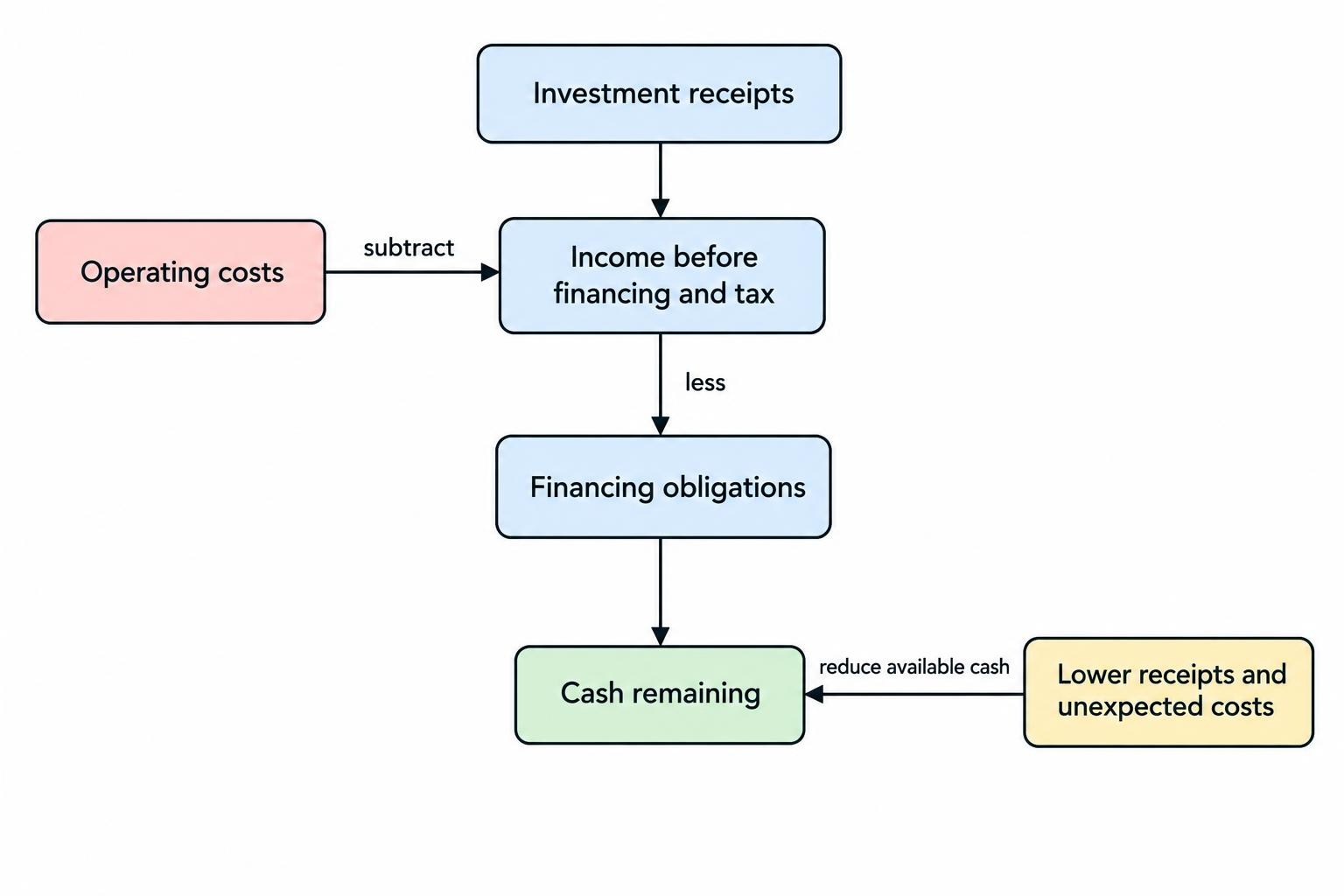
These assumptions should be specific enough to calculate. If a property’s annual receipts fall from €18,000 to €15,000 while its €6,000 operating costs remain unchanged, the income before financing and income tax falls from €12,000 to €9,000. A 16.7% decline in receipts produces a 25% decline in that income measure.
The calculation becomes more sensitive when fixed debt payments are added. That is why the amount of cash remaining after contractual obligations matters alongside the headline return.
Account for existing exposure to Madeira
An investor who already owns a home and earns a salary or business income in Madeira has regional exposure before buying another asset. Adding a local rental property may increase dependence on the same economic conditions.
Different asset labels do not necessarily provide different sources of risk. A tourism business and accommodation property may both suffer from weaker visitor demand. A local customer base may also overlap with the investor’s existing source of income.
Portfolio construction should consider those connections. The appropriate amount of additional Madeira exposure depends partly on what the investor already owns and the cash obligations those assets create.
Define the practical exit conditions
Liquidity should be assessed before committing capital. Listed shares can usually be offered for sale through a broker, but the achievable price depends on available buyers and trading conditions. Property and private businesses can require a lengthy sale process.
The holding period should allow for that difference. Money needed for a known near-term obligation creates a poor match with an asset whose sale depends on negotiations, financing approvals or shareholder consent.
An investment review should also define what evidence would justify selling. For a company, this might be a sustained deterioration in cash generation. For property, it might be an increase in required expenditure that makes the expected return inadequate. For a private business, it might be a governance failure that prevents reliable assessment of performance.
Those conditions give the investor a basis for action when circumstances change, while the investment can still be sold or restructured on manageable terms.