Madeira by bus works best when you build the day around the timetable, rather than treating the bus as a cheaper taxi. Choose a destination, check the return journey, then decide what fits between the two. That approach leaves room for sightseeing without turning the afternoon into a search for a ride home.
This guide covers the SIGA network, useful routes, tickets and the checks worth making before you travel. For a comparison with driving, taxis and organised transfers, see our guide to getting around Madeira.
How Madeira’s bus network works
SIGA is the public bus network serving Madeira and Porto Santo. Its three operators are Horários do Funchal, Companhia de Autocarros da Madeira, usually shortened to CAM, and SIGA Rodoeste. You may encounter both the network name and the operator name while planning a journey.
Route renumbering began in March 2026. Older articles, saved screenshots and accommodation instructions can therefore contain numbers that no longer match the bus display. The official SIGA passenger information covers the numbering changes, GIRO tickets, payment and passenger assistance.
You can buy a ticket on board with cash; bank cards are not accepted for those purchases. Alternatively, buy and load a GIRO ticket card before travelling. Operator counters, participating Payshop agents and available ticket machines provide purchase or loading options. Validate your loaded ticket whenever you change routes.
For wheelchair travel, contact the operator before committing to a departure. SIGA provides a booking process for suitable vehicles, rather than promising that every arriving bus will meet every access requirement.
Useful Madeira bus routes to check
Search by destination as well as route number. The official SIGA timetable directory displays old and current numbering where available and lets you open the relevant service. These routes provide useful starting points:
| Destination or service | Current route number | Older number |
|---|---|---|
| Monte via Corujeira de Dentro | 020 | 20 |
| Monte via Largo da Fonte | 021 | 21 |
| Jardim Botânico | 031 | 31 |
| Funchal–Curral das Freiras | 181 | 81 |
| Funchal–Camacha | 625 | 129 |
| Caniçal–Baía d’Abra listing | 702 | 113 |
| Aerobus between Funchal and the airport | 500 | Aerobus |
Treat these as search references, not a substitute for opening the timetable. Check the departure’s full destination, route variation and stop list. A familiar number alone does not establish that a bus reaches the stop you need.
For Monte, choose the stop around the attraction you intend to visit, rather than assuming every Monte service leaves you at the same entrance. Our guide to visiting Monte covers the gardens and attractions separately, so you can match the transport to the visit.
How to read a timetable without missing the important bit
Start with your travel date. Portuguese timetable labels commonly include dias úteis for working days, sábados for Saturdays, and domingos e feriados for Sundays and public holidays. Read any school term or school holiday notes too. A departure shown in the wrong column is not a backup option.
Next, establish what the printed time represents. Is it the departure from the route’s starting point, an intermediate timing point, or an estimated passage at your stop? Do not copy a terminal departure time into your plans as though it were the boarding time outside your hotel.
For journeys west of Funchal, the Rodoeste timetable search covers services linking destinations including Câmara de Lobos, Ribeira Brava, Ponta do Sol, Calheta and Porto Moniz. The operator also warns that timetable estimates can vary with traffic.
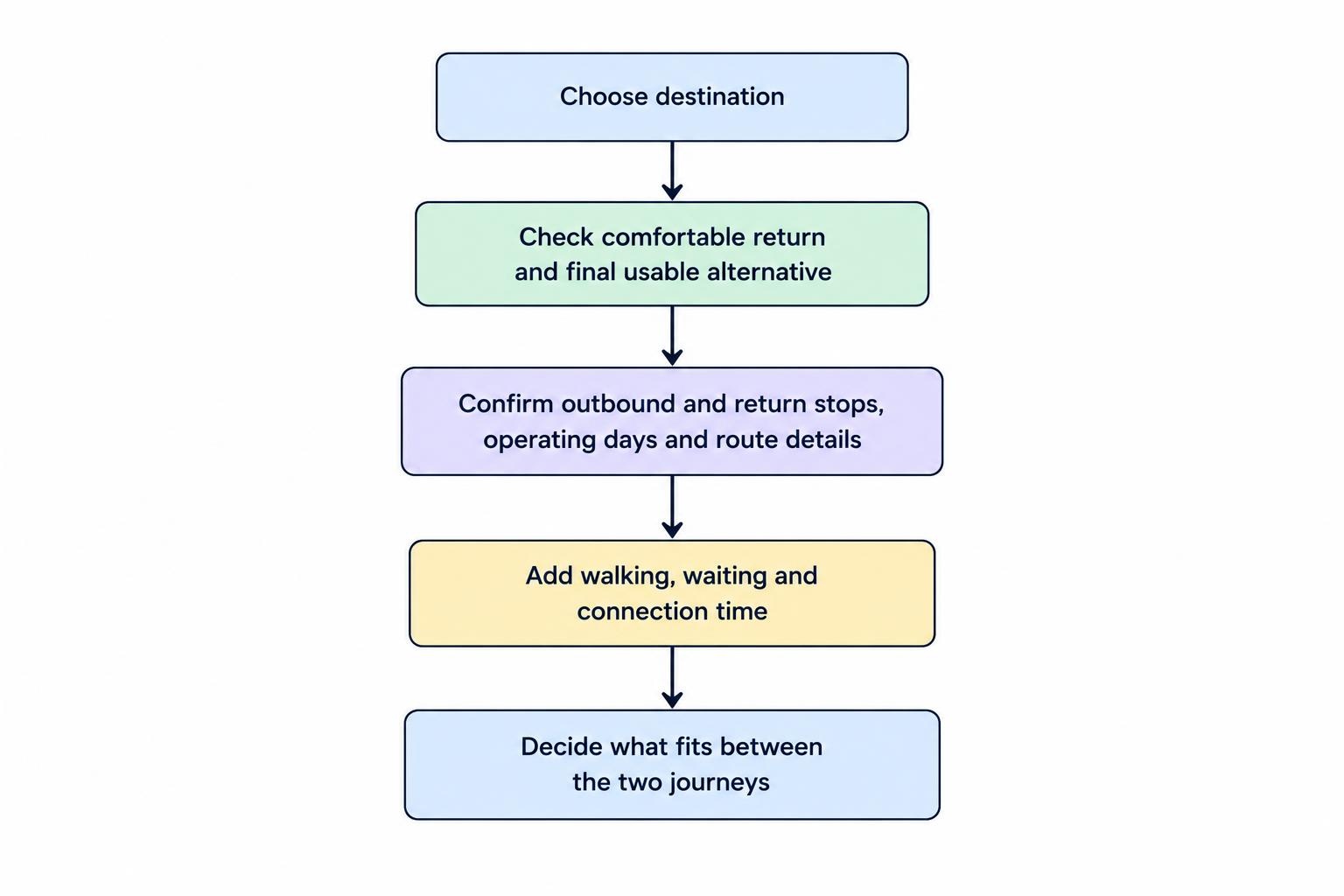
Build a journey in this order:
- Find the return first. Identify a comfortable departure home and note the final usable alternative.
- Confirm both boarding points. Save the outbound stop and the return stop separately.
- Read the footnotes. Check operating days, route variations and any required change of bus.
- Add walking and waiting time. Include the distance between stops, attractions and any connecting service.
For a connection, allow enough time to arrive late, locate the next stop and board without rushing. A connection that works only if both vehicles arrive to the minute is a fragile plan, especially when it is the last workable journey home.
Madeira bus tickets and fares
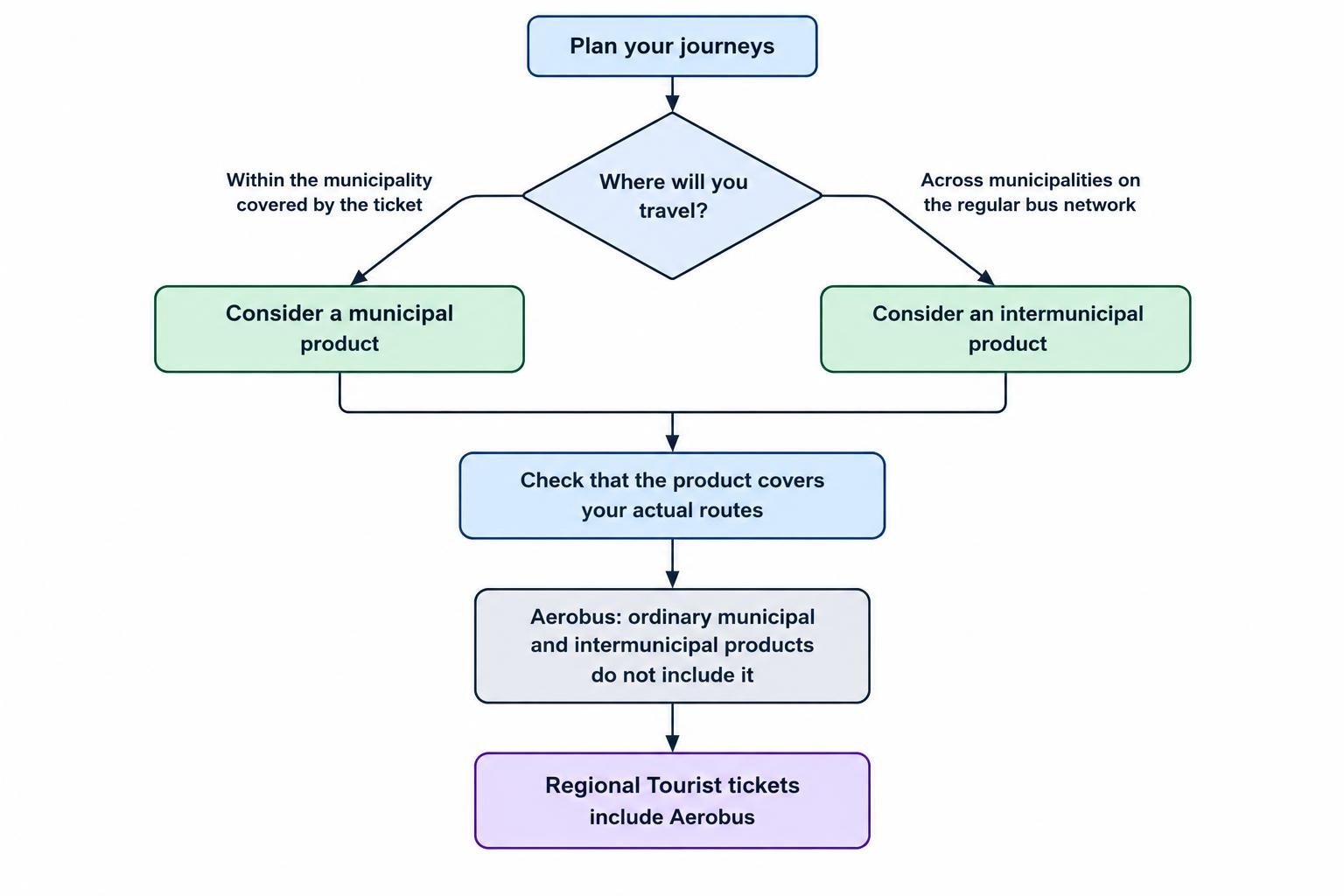
The main distinction is municipal versus intermunicipal travel. A municipal ticket covers the municipality for which it is bought; an intermunicipal ticket covers the wider regular bus network. Neither category includes Aerobus. The published 2026 bus tariff lists these adult prices:
| Adult ticket | Municipal | Intermunicipal |
|---|---|---|
| Single bought on board | €2.05 | €2.65 |
| Prepaid single journey | €1.45 | €2.00 |
| 24-hour ticket | €4.95 | €6.55 |
| Seven-day ticket | €23.50 | €31.10 |
The GIRO Bilhete card costs another €0.50. Ordinary prepaid journeys are loaded in quantities of at least two. Daily products run from the first validation; the one-day ticket lasts 24 hours.
Prepaid municipal journeys permit transfers within 45 minutes on the same operator, within the ticket’s coverage. Intermunicipal journeys permit transfers within 90 minutes across operators. These are validation windows, not permission to ignore the ticket’s coverage.
Aerobus costs €6.70 bought on board or €5.55 prepaid. Regional Tourist tickets include Aerobus, unlike ordinary municipal and intermunicipal daily tickets.
Which ticket should you choose?
Count the journeys you expect to make before buying a daily or weekly product. A day spent walking around one destination may involve only an outward and return ride. Paying for unlimited journeys brings little benefit if you do not use them.
Compare the ticket’s validity with your actual schedule too. An airport-inclusive product may be useful at the beginning or end of a stay, but less useful if the airport journey falls outside its validity. Write down the rides you intend to take, then compare the totals.
Do not buy a municipal product solely because your accommodation is in that municipality. Buy for the journeys you intend to make. If the route crosses a boundary and you are unsure which ticket applies, confirm the destination at the sales counter before loading the card.
Boarding, stops and everyday practicalities
Keep small euro notes and coins available if you intend to pay the driver. Have your destination ready, ideally written on your phone, and check the bus display before paying. This is particularly useful where several services use nearby stops or where a place name appears in more than one route description.
Save a screenshot of the timetable, the stop location and any footnotes. Include the direction of travel in the screenshot’s filename or your notes. Two identical-looking timetable images are surprisingly unhelpful when you are trying to work out which one gets you home.
At an unfamiliar stop, arrive early and make yourself visible as the bus approaches. Keep your ticket accessible throughout the journey. Before getting off, check that you have your phone, wallet and any bags; sorting out forgotten luggage is not a worthwhile addition to the itinerary.
With luggage, a pushchair or reduced mobility, check the walking approach as carefully as the bus route. Review steps, gradients and crossings between the stop and your accommodation. The shortest line on a map is not always the most manageable route with a suitcase.
Using the bus from Madeira Airport
For an airport journey, check the Aerobus timetable against the time you expect to leave the terminal, not simply the flight’s scheduled landing time. Allow for disembarking, baggage collection and finding the stop. Save a later departure as a backup rather than making the first possible bus the only workable option.
On the return journey, work backwards from your airline’s required airport arrival time. Add the journey to the airport, a waiting allowance and the walk from your accommodation to the stop. If that calculation leaves no reasonable margin, arrange another form of transport.
Check the stop closest to your accommodation, but also assess the final walk. A slightly longer bus ride may be preferable to dragging luggage along an awkward approach. Our guide to Madeira Airport transfers compares the arrival options without duplicating the route planning here.
Can you reach Madeira’s hikes by bus?
Assess each hike separately. Search for the actual trailhead and finish, not just the nearest village. Then check whether the bus stop gives you a sensible walking approach. A service to a nearby settlement does not establish that it provides practical access to the start of a trail.
There is a dedicated Horários do Funchal service between Funchal and Pico do Areeiro, with seasonal timetable information. Check that service’s own operating details rather than assuming the ordinary city timetable applies.
For a walk that finishes somewhere different, arrange transport from the finish before setting out. The bus that delivered you to the start does not solve the return journey. Keep the walking route, trail access arrangements and transport booking as separate checks.
Be conservative when matching a walk to a return departure. Include breaks, slower sections and the approach back to the stop. If the plan requires rushing the final part of the walk, choose an earlier start, a shorter route or different transport. A cheap fare stops being cheap when it creates an unplanned taxi journey.
Planning day trips and choosing a base
For a trip built around buses, compare accommodation using real journeys before booking. Pick two or three places you want to visit and work out the outward and return services from each possible base. Include the walk from the accommodation, not just the journey from the town centre.
Use one main destination as the starting point for each day. Add a second only after confirming the connection and the journey home. This makes it easier to see whether you have time for lunch and sightseeing, rather than just enough time to photograph the bus stop.
Consider a proposed beach day: compare arrival time, the walk to the beach, and the departure you would comfortably catch afterwards. If the useful visiting time feels too short, choose somewhere else or use different transport for that day. A route existing on the map does not automatically make it a good excursion.
For a complete holiday structure, our seven days in Madeira without a car itinerary separates the daily sightseeing decisions from the ticket and timetable details covered here.
Before you leave for the stop
Recheck the service close to departure, particularly if you saved the timetable well before the trip. Confirm the travel date, direction, stop and return arrangement. Keep the relevant operator’s contact details available if a service change would affect the day.
Carry enough cash for an alternative ticket purchase, keep some phone battery in reserve and know what you will do if you miss the planned return. That might mean taking an earlier bus, shortening the visit or using a prearranged transfer.
The most useful bus plan is not the one with the most destinations. It is the one that gives you enough time at the place you wanted to visit, with a clear and affordable way back.