Funchal Old Town, usually called the Zona Velha, is best visited on foot. Rua de Santa Maria provides the main thread, with painted doors, small lanes and places to eat. Short detours lead to Corpo Santo Chapel, the yellow São Tiago Fortress and the coast around Socorro.
This self guided walking tour starts at Mercado dos Lavradores and finishes near the waterfront at Jardim do Almirante Reis. Allow two to three hours, excluding a substantial lunch or swim. It works as a first morning in the city, leaving time for the wider attractions covered in our Funchal travel guide.
Plan Your Funchal Old Town Walk
Use the market as your starting point rather than beginning at the fortress. That puts the most time sensitive stop first and leaves the outdoor sights for later. A suggested start around 9am gives you time to browse before walking through the neighbourhood.
| Planning detail | Suggested approach |
|---|---|
| Starting point | Mercado dos Lavradores |
| Finishing point | Jardim do Almirante Reis, beside the waterfront |
| Approximate distance | Allow roughly 1.5 to 2 kilometres, depending on detours |
| Time to allow | Two to three hours with browsing and short stops |
| Walking conditions | Cobbled lanes, uneven surfaces and an uphill section around Socorro |
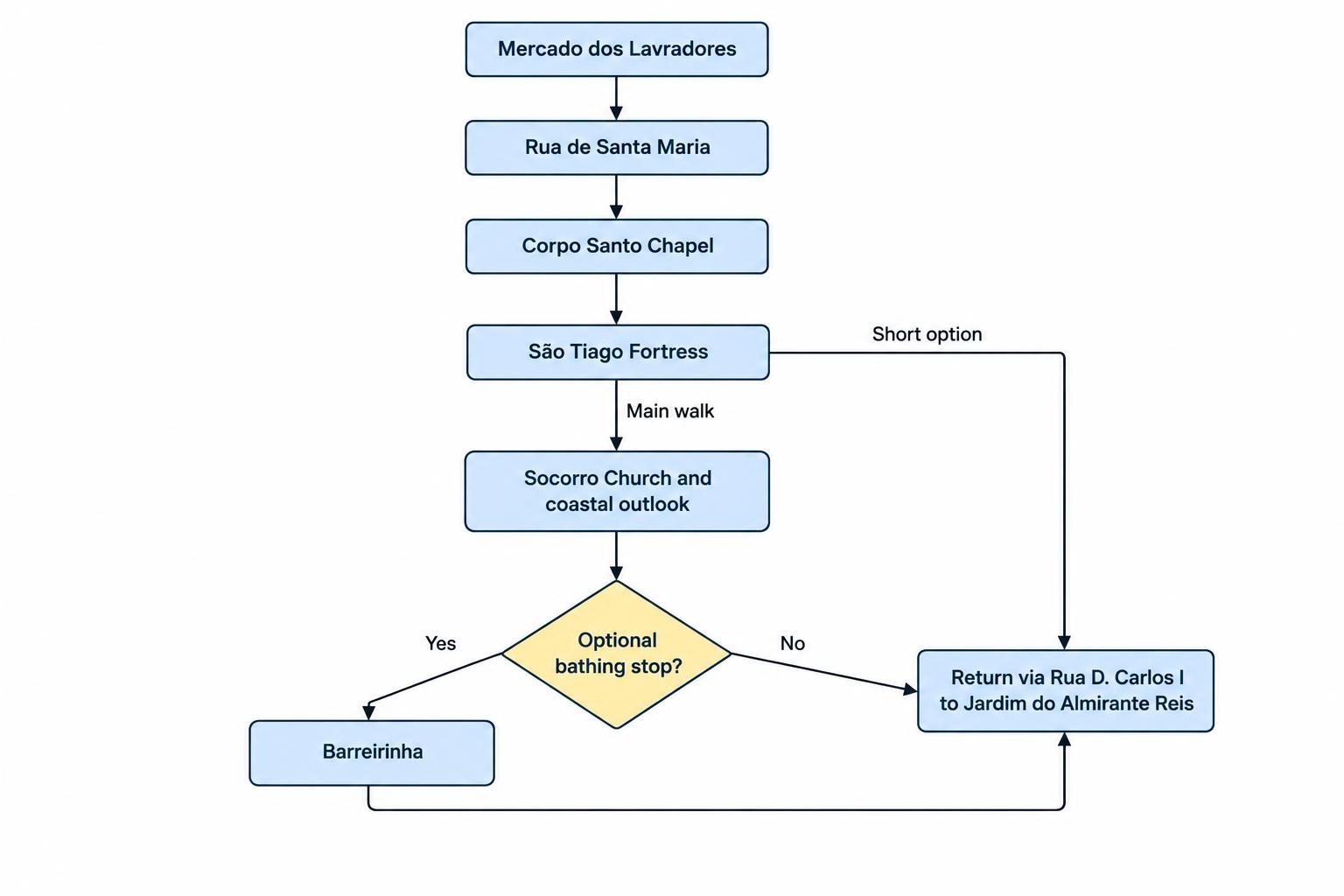
| Shorter version | Finish the outward walk at São Tiago Fortress, then return along Rua D. Carlos I |
Distances and timings are planning estimates, not a measured walking track. Save the stops in your map app before setting off: Mercado dos Lavradores, Rua de Santa Maria, Capela do Corpo Santo, Fortaleza de São Tiago, Igreja do Socorro, Complexo Balnear da Barreirinha and Jardim do Almirante Reis.
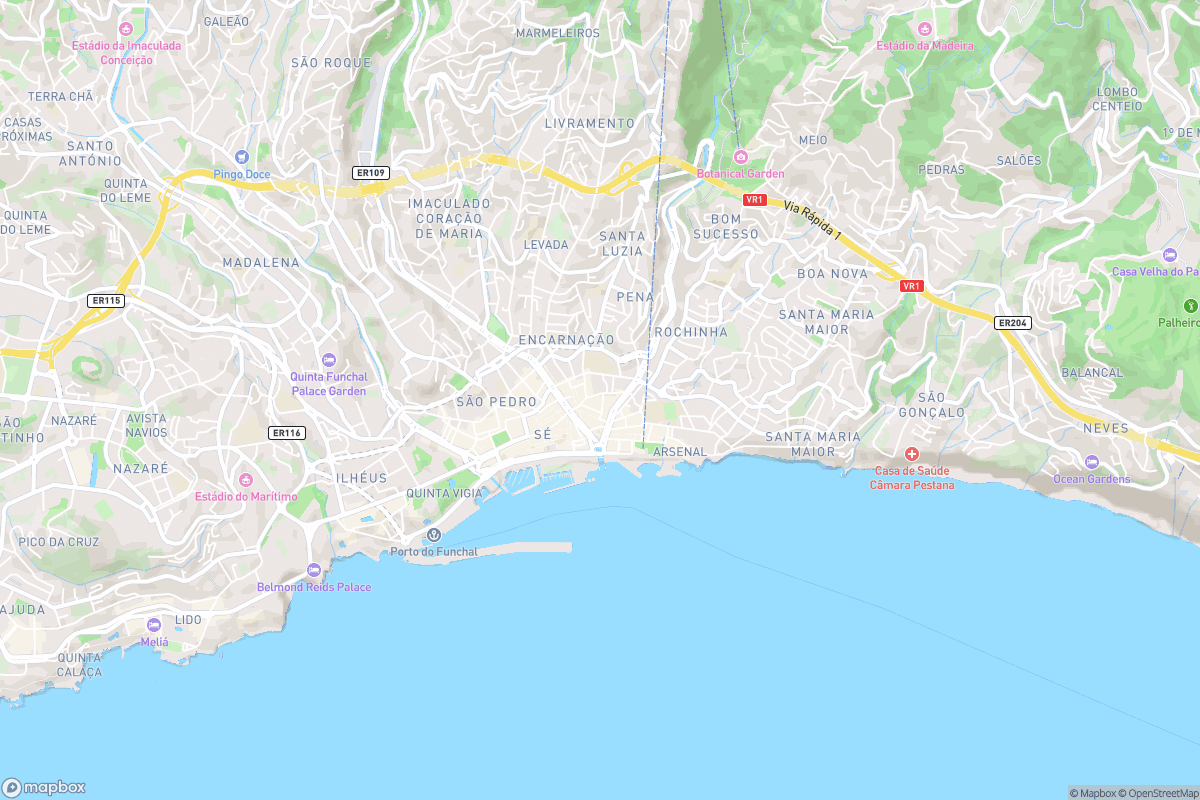
You do not need to enter every building to follow the route. Treat church interiors, fortress access and swimming as optional additions rather than appointments that dictate the whole morning.
The Walking Route, Stop by Stop
1. Start at Mercado dos Lavradores
Begin outside Mercado dos Lavradores and take a moment to look at the building before going shopping. Opened in 1940 and designed by Edmundo Tavares, it belongs to a much later chapter of Funchal’s history than the surrounding old streets. Entry is free. The municipal market listing gives a Saturday closing time of 2pm and lists Sundays and public holidays as closed; check for holiday exceptions before planning around a visit.
Inside, divide your attention between the building and the stalls. Look at the tiled decoration, browse the produce and flowers, and include the fish section if it is operating during your visit. Do not assume that every trader keeps the same hours as the market building.
Give yourself around 25 to 35 minutes rather than treating this as a quick corridor on the way to the painted doors. That is enough for an initial circuit and a closer look at anything you might buy.
Before accepting a fruit tasting, ask what it is and how much it costs. Confirm whether the displayed price is per kilogram or per item, then agree on the quantity before anything goes into a bag. A sample is an invitation to taste, not an obligation to purchase.
Keep purchases manageable. A large bag of fruit becomes less appealing once you start carrying it uphill. Leave the market and find the western end of Rua de Santa Maria, just south of the building, then head east into the Old Town.
2. Follow Rua de Santa Maria and Its Painted Doors
Rua de Santa Maria is the main sightseeing stretch of this walk. Its doors and façades became canvases through the painted doors project, bringing public art into the neighbourhood’s narrow cobbled streets. The Madeira tourism board’s Old Town overview places the street among Funchal’s oldest and identifies the artwork as part of the area’s character.
Walk slowly and look at both sides rather than searching for a single “best” door. Compare how artists use the shape of an entrance, its panels and the surrounding wall. The most interesting detail may be something small that disappears in a photograph taken from farther away.
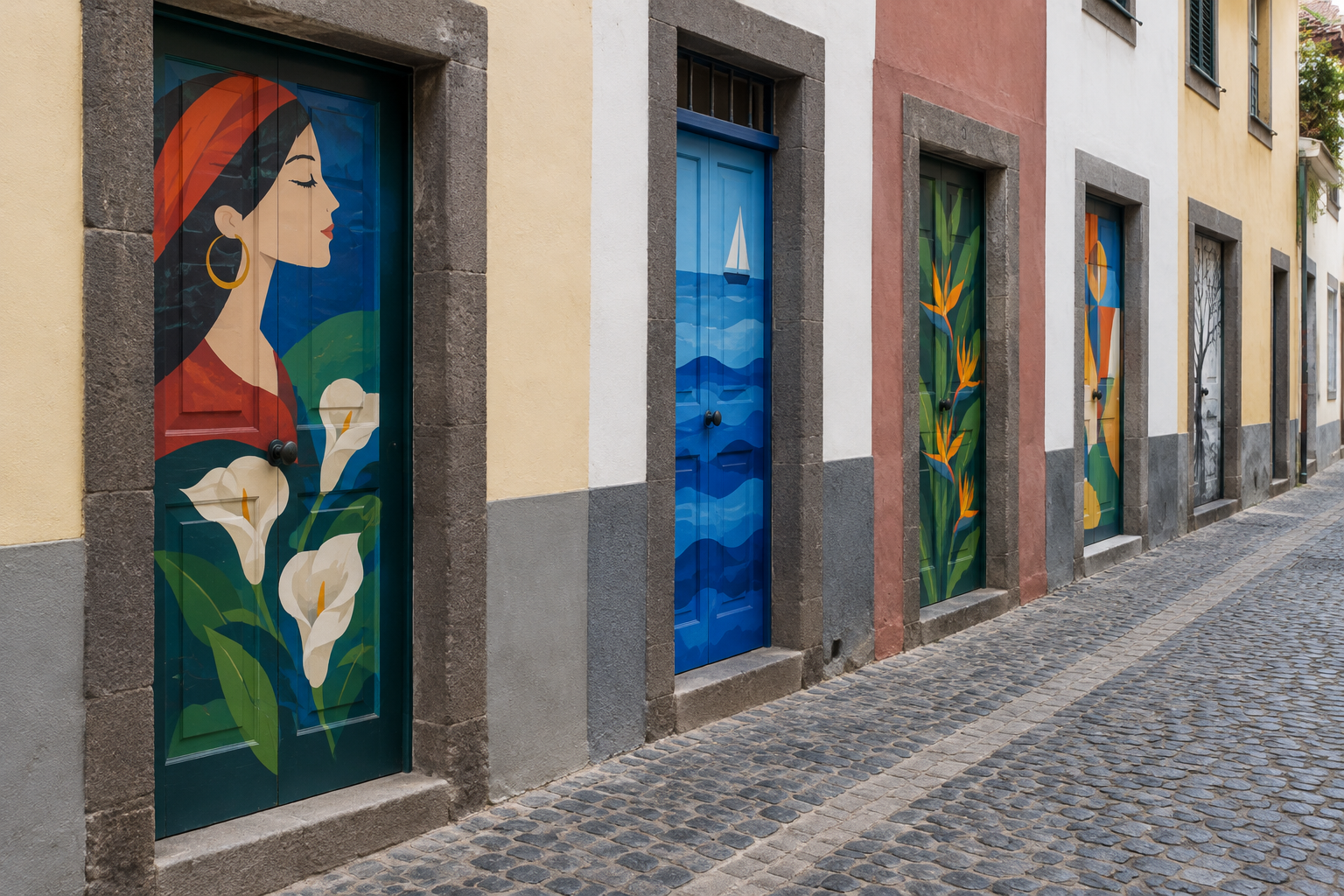
A morning visit is a sensible choice if photography matters: an open door can conceal the very painting you came to see. It still belongs to a working building, though. Do not close doors, move furniture or block an entrance for a better composition.
Take a short look into the adjoining lanes, but keep Rua de Santa Maria as your reference point. You will return to the seafront on the way back, so there is no need to squeeze every side street into the outward walk.
3. Detour to Corpo Santo Chapel
Leave the main street for Largo do Corpo Santo and its small chapel. Built by seafarers in the 15th century and dedicated to São Pedro Gonçalves Telmo, the chapel reflects the neighbourhood’s longstanding connection with maritime work. That history forms part of Santa Maria Maior parish’s account of its maritime heritage.
This is a useful place to slow down after the painted doors. Look at the chapel’s scale, its entrance and its relationship with the square. It offers a different point of interest from the brighter artwork along the main street.
If the chapel is open to visitors, enter respectfully and keep your visit brief during religious activity. If it is closed, the exterior still makes a worthwhile stop; do not wait indefinitely for access.
Allow about five to ten minutes here, then continue east towards São Tiago Fortress. Keep the sea on your right as you approach the next stop.
4. Reach São Tiago Fortress
The yellow walls of Fortaleza de São Tiago mark the seafront end of this part of the walk. Construction began in 1614 as part of Funchal’s defences against corsair attacks. Its position above the shore makes that purpose easy to appreciate without a lengthy military history lesson. The official São Tiago Fortress description covers its origins and later changes of use.
Begin with the exterior. Step back far enough to see the walls in relation to the sea, rather than photographing only the entrance. This is also a good point to look west along the waterfront and get your bearings.
Do not build the route around guaranteed access to terraces or interior rooms. Follow the notices at the entrance and visit only areas open to the public. The fortress remains a useful landmark even if you spend the entire stop outside.
Allow around 15 minutes for the exterior, longer if access permits a fuller visit. To shorten the walk, turn west from here and return along Rua D. Carlos I towards Almirante Reis. Otherwise, head back up to Rua de Santa Maria and continue east towards Largo do Socorro.
5. Continue to Socorro Church and the Coastal Outlook
The next section brings a little climbing, so ease the pace rather than treating the church as another quick photo stop. Igreja do Socorro stands at Largo do Socorro. The city’s Socorro Church entry records the present church’s completion in 1768 and its role as the parish church of Santa Maria Maior.
Look around the square and the coastal outlook before deciding whether to go inside. The change from enclosed lanes to an open view is the reason to carry on beyond the fortress. Give yourself a few minutes without trying to fit another attraction into the same pause.
If the church is open and welcoming visitors, step in quietly. Dress appropriately, silence your phone and leave photography until you have checked the rules. Opening hours do not override services or other religious use.
This is the eastern turning point of the main route. You do not need to continue into the streets farther uphill. The next stop is the Barreirinha waterfront below the church area, followed by a return west through the neighbourhood.
6. Make Barreirinha an Optional Swimming Stop
Barreirinha is a rocky bathing complex, not a sandy beach. Access to the sea is by steps, and entry is paid. Facilities include showers, toilets and a first aid post, as recorded in the Blue Flag programme’s Barreirinha beach profile.
For this walking tour, seeing the coast is enough. Enter the bathing complex only if you have brought swimwear and want to give it proper time. Adding a swim changes the outing from a sightseeing morning into a longer visit, which is perfectly reasonable provided you have not booked something immediately afterwards.
Check the current opening arrangements, admission charge and sea conditions at the entrance. Follow staff instructions and any restrictions. Do not assume that sunshine means suitable swimming conditions.
If you are staying dry, pause in the surrounding public area before heading back. Avoid searching for a continuous waterside shortcut through the fortress or bathing complex; use the public streets for the return.
7. Return Through Rua D. Carlos I to Almirante Reis
Return towards the fortress using the public streets, then join Rua D. Carlos I and walk west towards Jardim do Almirante Reis. This gives the return a different emphasis from the outward walk: more waterfront, fewer pauses to inspect doors.
You can finish beside the garden or continue back to the market if you need to collect your bearings. Resist the temptation to turn the final stretch into a race through every sight you missed. Choose one short detour, or leave the remaining lanes for another visit.
The lower cable car station is near this end of the route. If you want to continue uphill, plan that as a separate part of the day using our guide to visiting Monte. Check the service status and allow time for transport and your chosen attraction rather than treating Monte as a ten minute extension.
Where to Fit Lunch Into the Walk
The simplest arrangement is to finish the route before choosing lunch. It gives you a chance to compare menus during the walk without committing to the first available table. If you prefer a longer break midway, stop around the central Old Town and then continue to the fortress and Socorro.
Read the menu before sitting down. Check prices, portion sizes and whether a fish dish is priced by weight. Ask whether bread, olives or other items brought to the table carry a charge, and decline anything you do not want.
Use our guide to traditional Madeira dishes to decide what you would like to try before comparing restaurant menus. The useful question is not which doorway looks most photogenic, but which kitchen is serving the meal you actually want.
Keep the schedule loose enough to eat without watching the clock. Two hours works for a selective walk; three hours gives you more room to browse. A full meal or swim needs additional time.
Practical Tips and Route Adjustments
For reduced mobility: do not treat this as a certified accessible route. Cobblestones, uneven thresholds and gradients need individual assessment. A shorter visit around Almirante Reis, Rua D. Carlos I and the fortress exterior may be more manageable than the full circuit. Check entrances separately if you use a wheelchair or mobility scooter.
For wet weather: wear shoes with a dependable grip and shorten the exposed coastal stops if conditions deteriorate. Do not rely on churches being open as rain shelters. Carry a light waterproof layer rather than planning to buy one halfway through the walk.
For families: make the painted doors a looking game, keep the market visit focused and build in a seated break. Supervise children near traffic, waterfront edges and bathing access points. The shorter fortress turnaround is a useful option before everyone gets tired.
For costs: the route can remain a walk through public streets, with no need to buy a guided tour or enter a paid attraction. Budget separately for food, purchases, transport and optional swimming. Keep those additions optional and the morning stays straightforward: market, lanes, chapel, fortress and coast, at a pace that leaves time to notice them.