Driving in Madeira is manageable if you choose your routes carefully and feel comfortable with hill starts, tight bends and unfamiliar junctions. The main roads are not the same experience as a steep lane leading to a hillside apartment. That distinction matters more than the island’s reputation for difficult driving.
The practical approach is to use main routes for longer journeys, slow down before narrow sections and check where you will park before arriving. On descents, control your speed with the gearbox rather than relying entirely on the brakes. Give yourself room to make decisions, particularly during your first day behind the wheel.
Choose the road, not just the destination
Madeira’s main routes and mountain roads demand different levels of attention. The official Madeira transport and driving information distinguishes straightforward driving on most main roads from the sharper curves found in mountainous areas. It also confirms that the island’s expressways and main roads have no tolls.
For a first drive, favor the signed main route rather than accepting every shortcut offered by your navigation app. A route that saves a few minutes can be a poor trade if it adds an awkward climb or several tight turns.
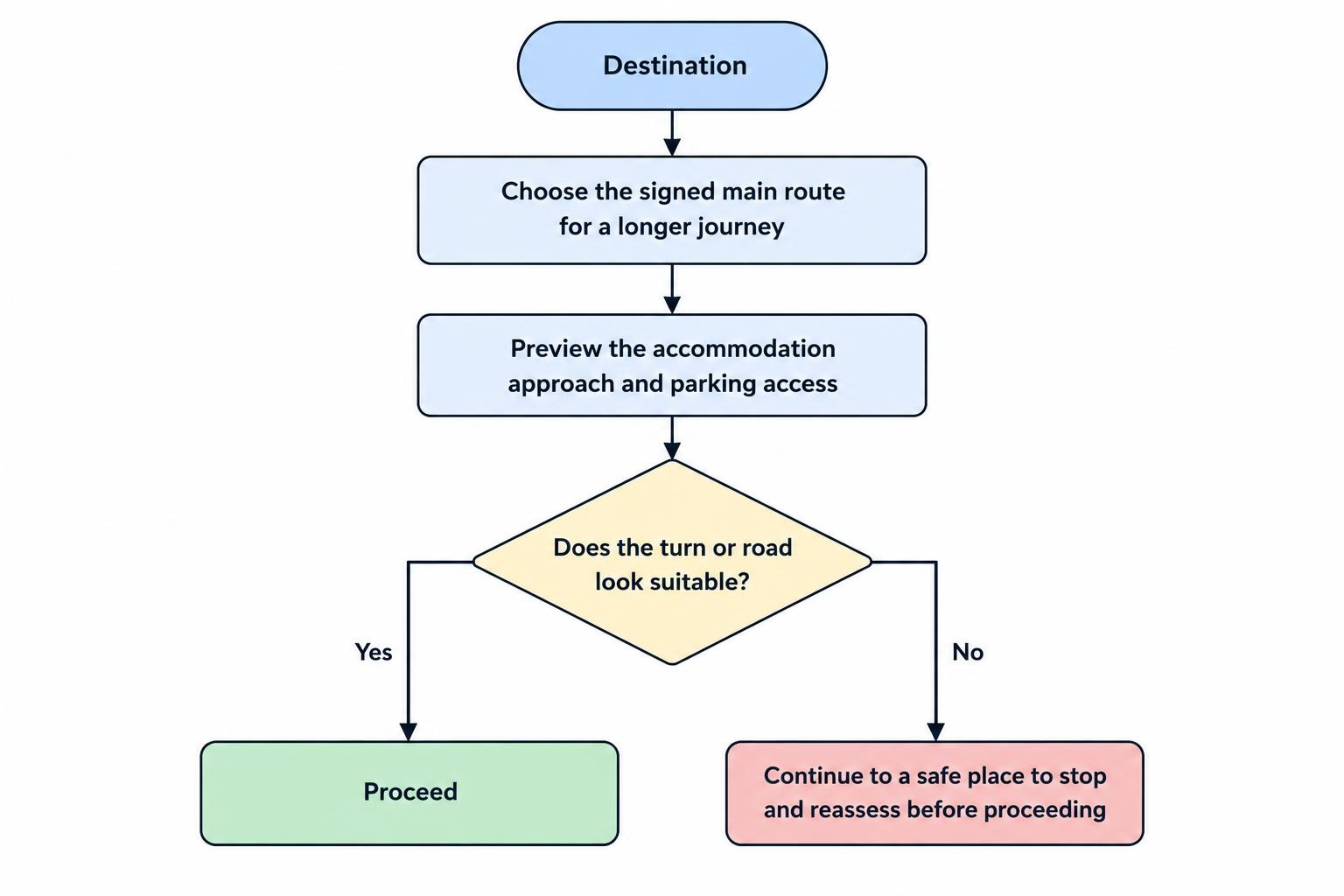
Preview the final approach to your accommodation before setting off. Ask the property which entrance drivers should use, whether the access road allows two cars to pass and whether the parking entrance involves a steep ramp. A map pin identifies a building, not necessarily its most convenient driveway.
Download an offline map and set the destination while parked. If a turn looks unsuitable, continue until you can stop safely and reassess. Missing a junction is inconvenient; forcing an uncertain maneuver is a worse option.
Get familiar with the car before the first climb
Before leaving the collection area, locate the headlights, hazard lights, parking brake and reverse gear. Adjust the seat so you can press the pedals fully without stretching. Check how the transmission offers a lower gear or manual selection mode, rather than trying to work it out halfway down a hill.
An automatic can reduce the workload if you rarely drive a manual, but it does not remove the need for controlled descents. Nor should you assume that every automatic has hill hold, or that the feature will keep the car stationary indefinitely.
Choose a car you can place accurately on the road and maneuver confidently. If you are still deciding between vehicle types, the guide to renting a car in Madeira covers the booking decisions separately. Here, the priority is knowing how to operate the vehicle you actually receive.
How to handle Madeira’s steep hills
Climbing and starting on an incline
Approach a climb with a suitable gear already selected. In a manual car, change down before the engine struggles rather than waiting until the car has almost stopped. Leave enough space behind the vehicle ahead to avoid repeatedly stopping and restarting on the steepest part.
For a manual hill start, use the parking brake to hold the car while preparing to move. Find the clutch’s biting point, apply suitable power and release the parking brake when the car is ready to pull forward. Practice somewhere safe before attempting an unfamiliar incline in traffic.
Do not hold a stationary manual car on the clutch and accelerator. Use the brake while waiting. In an automatic, keep the foot brake applied until you are ready to move and use the controls as directed for that vehicle.
If the car stalls, secure it before restarting. There is no benefit in rushing because someone behind seems impatient. A controlled restart is the job; entertaining the queue is not.
Descending without riding the brakes
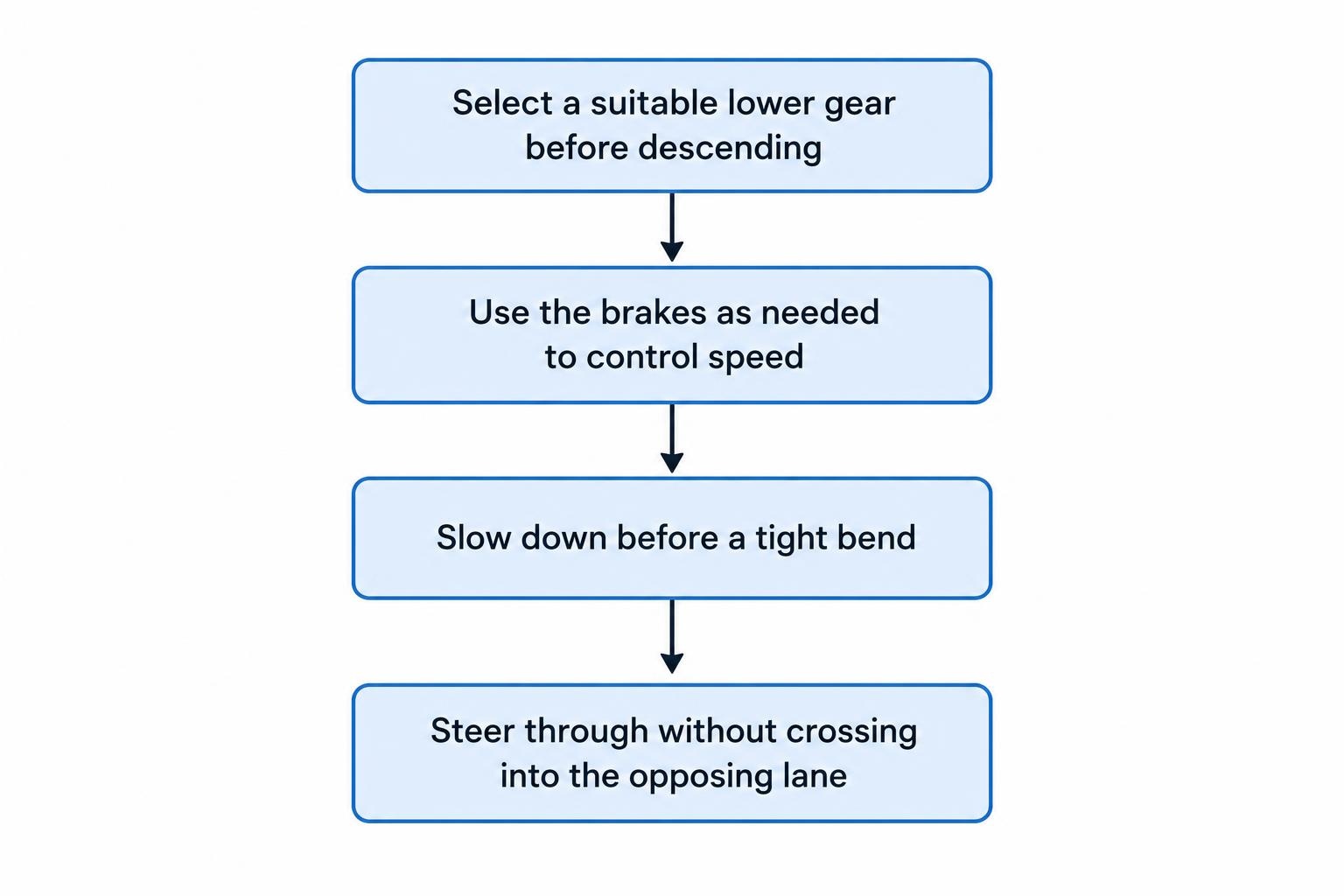
Select a lower gear before a sustained descent. In an automatic, that may mean using manual selection, paddles or another setting identified in the vehicle’s instructions. Madeira’s official road guidance recommends lower gears on descents rather than depending only on the brakes.
Use the brakes when needed to keep the speed appropriate, but avoid maintaining speed through continuous light pressure alone. If the car keeps gathering speed, slow down and select a more suitable gear within the vehicle’s operating range. Do not coast downhill in neutral.
Brake before a tight bend so you enter it at a controlled speed. Look through the turn without cutting across the road, and leave room for an approaching vehicle. A comfortable descent should not feel like a series of last second corrections.
If you notice a burning smell, a brake warning or a change in braking response, stop somewhere safe. Do not continue downhill to see whether the problem disappears. Contact the rental company or roadside assistance before proceeding.
Passing on narrow roads and using roundabouts
Drive on the right and keep your position predictable. On a narrow road, look ahead for places where vehicles can pass rather than continuing until both drivers have nowhere to go. Wait before the constriction if another vehicle is already approaching through it.
For steep sections too narrow for opposing vehicles to pass, Article 33 of the Portuguese Highway Code generally requires the descending driver to give way. Reversing has separate rules, including proximity to a suitable passing place. If an obstruction is only on your side, give way when passing it requires entering the opposing side.
Do not treat priority as a reason to press forward. Stop early, leave maneuvering space and avoid gestures that could be mistaken for an instruction to proceed. If reversing becomes necessary, check the whole path before moving.
At roundabouts, give way to vehicles already circulating. Use the right lane for the first exit. For later exits, move into the outer lane only after passing the preceding exit, checking carefully before changing lanes. Signal before leaving and follow any lane directions.
Read the approach signs early. If you miss your exit, take a safe route to correct the mistake rather than cutting across another vehicle. Give yourself more time at an unfamiliar junction, not a more ambitious maneuver.
Driving through Madeira’s tunnels
Prepare for a tunnel before entering it: check your speed, leave a sensible following gap and make sure the correct lights are on. Portuguese law requires dipped headlights during daylight in tunnels signed as such, under the Highway Code provisions on vehicle lighting. Do not assume daytime running lights provide the required lighting.
Maintain a steady position and follow the lane markings. If you are unsure whether a tunnel carries opposing traffic, read the signs rather than judging from its width. Avoid unnecessary lane changes, and do not brake abruptly simply because the surroundings become darker.
Know which exit comes next before entering. If navigation becomes uncertain, continue according to the road signs until you can reassess safely. Never reverse or turn around in a tunnel to recover a missed route.
At the exit, allow for a change in brightness and weather. Keep your attention on the road instead of immediately looking at the view.
If the car breaks down, switch on the hazard lights and move out of the traffic flow only if it is safe to do so. Follow the tunnel’s posted emergency instructions and use any available emergency communication equipment. Do not walk along a live traffic lane to search for phone reception.
Parking in Madeira: markings, payment and reserved spaces
Read the sign beside the bay before leaving the car. Paint gives an initial indication, but it does not tell you every restriction, charging period or reservation that may apply.
| Marking | Usual meaning | What to check |
|---|---|---|
| Blue lines | Paid parking | Charging hours, maximum stay and payment instructions |
| White lines | Generally free unless reserved or otherwise restricted | Nearby signs and any additional road markings |
| White bay marked “M” | Reserved for residents | Do not assume a visitor or rental car may use it |
| Yellow lines | No parking | Choose an authorized space elsewhere |
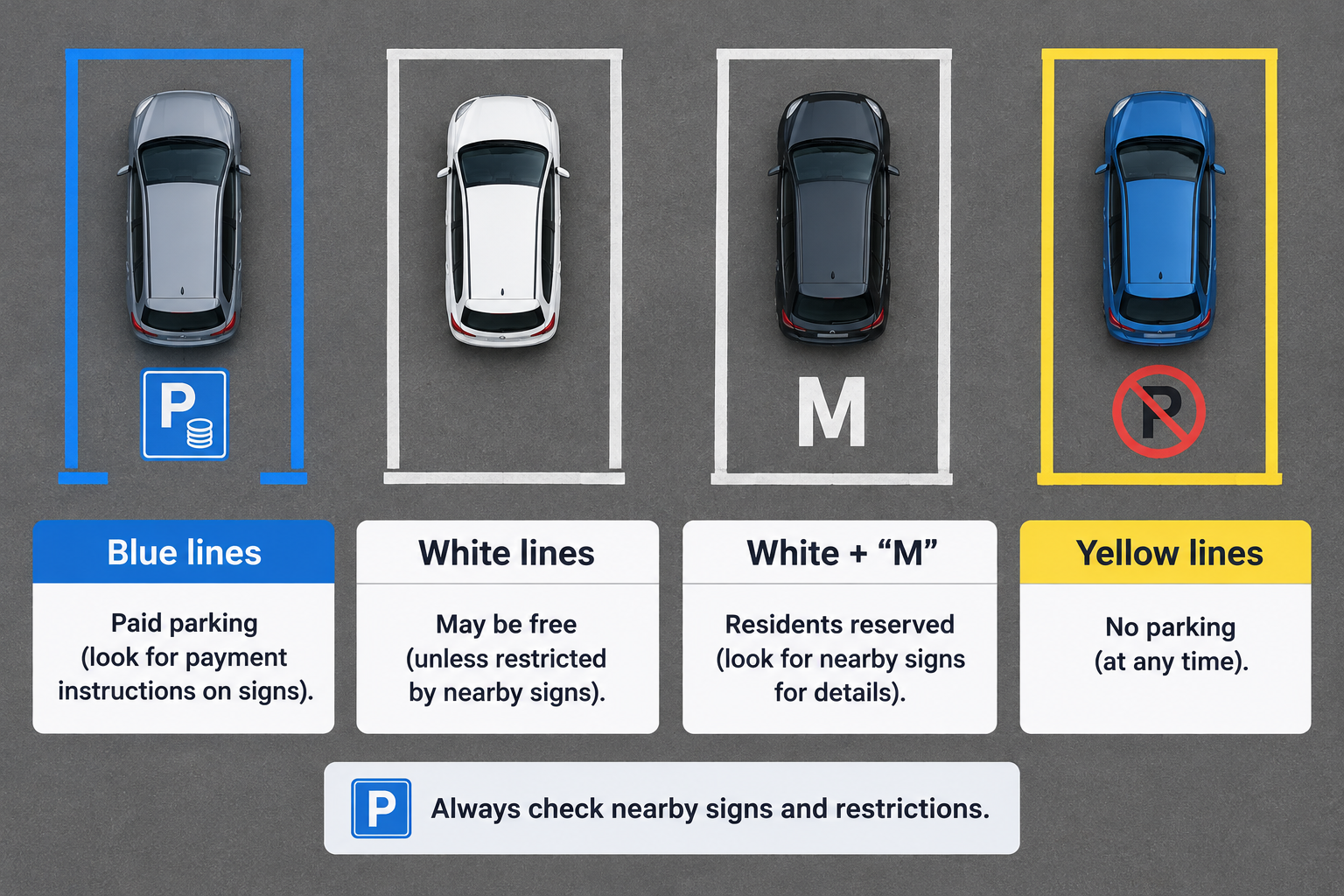
Funchal’s municipal parking meter regulations provide the local framework for metered spaces. Use the instructions displayed at your location rather than applying one charging schedule across the island. Check the payment confirmation, registration number and expiry time before walking away.
Carry some coins as a backup, but check the machine’s accepted payment methods. If you use an app, confirm that you have selected the correct parking area. A successful payment for the wrong location is not the result you need.
Make Funchal parking a separate decision
For a city visit, consider choosing a car park first and walking from there. Compare its location with your plans, then check opening hours, vehicle access, height restrictions and the arrangements for collecting the car after dinner. Do not assume overnight parking includes unrestricted access.
For accommodation, ask whether parking is on site, reserved and suitable for your vehicle. “Parking nearby” deserves a follow-up question. The guide to choosing where to stay in Funchal can help you consider the area alongside your transport plans.
Parking on a slope or near a viewpoint
Use an authorized bay and secure the car with the parking brake and the appropriate transmission setting. In a manual, follow the vehicle’s instructions for leaving it in gear; in an automatic, use the parking procedure provided for that model. Do not rely on one unfamiliar control without checking how it works.
At viewpoints and walking access points, leave space for other vehicles to turn and pass. An empty patch beside the road is not automatically a parking space. Never block a driveway, gate or access route because the intended stop will be brief.
Plan around visibility and road conditions
Check the route before a mountain drive and reassess if visibility deteriorates. Allow enough time to return without rushing. If your first encounter with a demanding road can happen in daylight, choose that option rather than adding darkness to an unfamiliar car and route.
Madeira’s regional roads authority describes INFO VIAS traffic information as a tool for checking congestion, interruptions, road restrictions and camera images. Use current notices before departure, then follow signs, barriers and instructions on the road. A saved map is not permission to enter a closed section.
In rain or fog, reduce speed and increase the space ahead. If you cannot judge the road comfortably, stop at a safe, authorized location rather than beside a blind bend. Keep the itinerary flexible enough to abandon a drive that no longer feels sensible.
Leave a buffer before flights, timed bookings and evening commitments. The aim is not to predict every delay, but to avoid turning a delay into pressure to drive faster.
When to leave the car parked
You do not need to drive every day to make a rental worthwhile. Consider leaving the car parked for a day centered on places you can reach comfortably on foot, or arranging transport for a route you do not want to tackle.
The wider guide to getting around Madeira compares the alternatives. Choose transport around the day’s actual plans rather than treating driving as an obligation.
The most useful Madeira driving habit is simple: make the next decision early. Choose the approach road before setting off, the gear before the descent and the parking place before entering the busiest streets. That leaves more attention for the road in front of you.