Avoiding forex broker scams requires checking who controls the account, what that company is authorised to do, and where the money goes. A professional website, a familiar trading platform and a displayed licence number are supporting details. Each can appear in a fraudulent operation.
The difficulty is that a scam can resemble an ordinary brokerage relationship for some time. Account balances may increase, customer support may respond promptly, and an initial withdrawal may succeed. None of those observations independently establishes that the provider is genuine or that the displayed trades occurred.
The most consequential forex broker scam warning signs involve inconsistencies between the company’s identity, regulatory claims, payment instructions and treatment of withdrawals. Those inconsistencies deserve more attention than awards, testimonials or promised returns.
A useful assessment separates several questions. Is the company genuine? Does it have the necessary permissions? Does the account agreement name that company? Are its charges and execution practices acceptable? Can a complaint reach an identifiable institution?
These questions remain relevant after the account opens. A broker can change its contracting entity, payment arrangements or trading conditions. Verification should continue whenever the relationship changes materially.
Distinguishing Broker Fraud from Trading Losses
Losing money does not establish that a broker is fraudulent. A leveraged position can produce a large account loss from a relatively small currency movement. Spreads, commissions and financing can also turn a marginally profitable strategy into a losing one.
An unexpected execution price needs investigation, but is not automatically evidence of manipulation. Prices can change between order submission and execution. Stop orders can also fill beyond their requested level during rapid movements or gaps, as explained in ESMA’s guidance on CFDs.
Fraud concerns deception, such as pretending to hold an authorisation, fabricating investment activity or diverting customer funds. Broker misconduct can also involve misleading sales practices, abusive execution or failure to comply with applicable rules. These issues require different evidence from a complaint that a trade lost money.
The distinction matters when deciding what to do next. A pricing dispute with an identifiable regulated company may require order records and a formal complaint. A fabricated brokerage demanding another payment before releasing funds calls for immediate attention to payment recovery and account security.
Likewise, poor service and fraud should not be treated as interchangeable. An unanswered support ticket is concerning, particularly when money is involved, but its meaning depends on the circumstances. Repeated contradictory explanations, unverifiable identities and payments to unrelated recipients provide a different pattern.
Use precise descriptions when recording a problem. “The company rejected my withdrawal on these dates and requested this additional payment” gives a bank or investigator facts to examine. “The broker is a scam because I lost” leaves the central questions unresolved.
Verify the Company and Its Regulatory Permissions
Identify the actual account provider
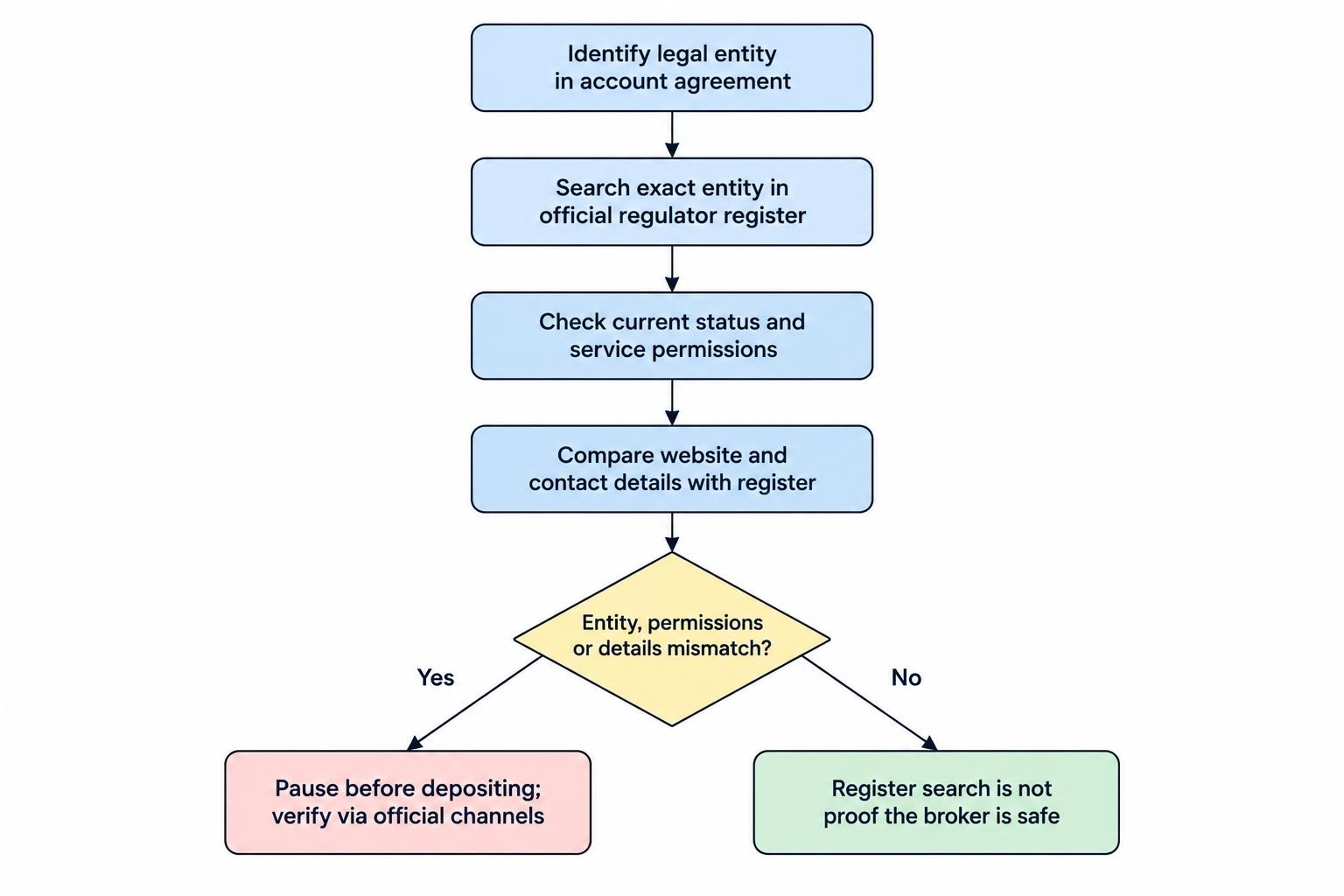
Begin with the legal name in the client agreement. International brokerage brands can operate through several companies, each subject to different rules. The group’s best known licence may belong to a company that will have no contractual responsibility for your account.
Compare the proposed agreement with the account opening confirmation and the information in the client portal. If the company changes during registration, establish why before depositing. A sales representative’s assurance that every subsidiary provides identical protection is insufficient.
The UK Financial Conduct Authority specifically advises CFD customers to check the contracting entity and warns that overseas companies can share trading names with UK firms. Its guidance for CFD investors also addresses the loss of protections that can accompany overseas arrangements or professional classification.
A certificate of incorporation answers a different question. It may establish that a company was registered, but does not establish permission to provide the investment service being advertised. The relevant evidence is the financial regulator’s record and the permissions attached to it.
Read the register entry
Access the regulator’s website independently. Search using the legal name and, where available, the licence or reference number. Read the status and permitted activities rather than stopping when the name appears.
Registers can contain historical entries. A firm that was previously authorised may no longer have permission to operate. The FCA’s authorisation guidance explains the difference between current authorisation and statuses such as revoked or no longer authorised.
The service category matters too. Permission for one financial activity does not necessarily cover forex dealing, discretionary account management or holding client money. A broker, an adviser and a money manager may have different responsibilities and authorisation requirements.
For Kenyan traders, the Capital Markets Authority’s licence register distinguishes online foreign exchange brokers from online foreign exchange money managers. Match the provider’s legal entity to the relevant category. A licence belonging to another member of the same corporate group does not resolve that check.
In the United States, NFA’s investor resources provide access to BASIC, a database containing CFTC registration, NFA membership, disciplinary and financial information. The appropriate verification route depends on the jurisdiction and service; a foreign licence is not a universal permission to solicit customers everywhere.
Check for a cloned identity
A fraudster can copy the name, address and registration number of an authorised firm. The copied information may be accurate while the website, telephone number and payment destination belong to someone else.
The FCA’s warning about forex trading scams describes this practice. It also notes that fraudsters may claim the regulator’s contact information is outdated, directing the prospective customer back to the scammer’s own channels.
Use independently verified contact details to confirm the website and the proposed account. If the register does not supply enough information, contact the regulator through its official website. Do not resolve an identity mismatch by asking only the person whose identity is in doubt.
Examine email domains carefully. A minor spelling change or an added word can distinguish an impersonator from the genuine firm. A secure connection to a website does not establish who operates the business behind it.
Understand what warnings establish
Search official warning lists using the company name, trading name and domain. Read the notice itself. A warning about unauthorised activity, an impersonation alert and a proven fraud finding describe different circumstances.
Absence from a warning list provides little reassurance on its own. The FCA’s warning list explicitly states that firms not yet listed may still be unauthorised or fraudulent.
Save the register entry and agreement with the date of the check. This creates a record of the information available when the account was opened and makes later changes easier to identify.
Examine Sales Tactics and Performance Claims
Guaranteed returns and automated trading claims
A promise of fixed profits from speculative forex trading requires close scrutiny. Currency prices, execution costs and trading outcomes are uncertain. Describing the strategy as automated does not remove those uncertainties.
The CFTC’s advisory on AI trading bots warns about fraudulent schemes using claims of artificial intelligence and guaranteed returns. Its examples include fabricated customer balances and programmes that conducted little actual trading.
Translate a return promise into a longer period. A hypothetical 10% monthly return, compounded for twelve months, would turn $10,000 into approximately $31,384 before costs and taxes. That arithmetic makes the scale of the claim easier to assess.
Performance evidence should cover losses as well as gains. A screenshot of profitable trades does not show the full account history, open losses, deposits or money withdrawn. A high win rate also says little without the average gain, average loss and exposure taken.
For example, nine gains of $10 followed by one loss of $150 produce a $60 loss despite a 90% win rate. The percentage of winning trades cannot establish that a strategy is profitable or that the person advertising it is trustworthy.
Pressure from account managers and online groups
An account manager may describe an urgent opportunity that supposedly requires a larger deposit. The practical effect is to compress the time available for checking the offer and increase the amount exposed.
Set the deposit decision independently of the sales conversation. A provider’s explanation should withstand written questions and a pause for verification. Pressure to borrow, conceal the payment or bypass a bank’s questions is a reason to stop the process.
Group chats create another source of pressure. Messages from apparent customers can make a platform seem widely used, but their identities and experiences may be unverifiable. The SEC’s warning about investment group chats describes groups that impersonate recognised experts to attract investors.
A recommendation from a genuine acquaintance also has limits. That person may have seen only an account balance or received an early payment. Ask what they have independently established about the company, rather than treating their confidence as evidence.
Reviews can help identify questions, but require similar care. Look for dated descriptions of withdrawals, fees and complaint handling. A large number of vague positive comments provides less useful information than a documented account of a particular process.
Follow the Money Before Making a Deposit
Check the recipient and payment instructions
The payment destination should be consistent with the contractual arrangement. If a broker uses a payment processor, obtain an explanation through a verified channel and confirm how the payment will be attributed to your account.
An unfamiliar beneficiary is not automatically fraudulent, but an unexplained one leaves a material gap. Do not accept a private message from a salesperson as sufficient confirmation that a personal bank account or wallet belongs to the brokerage.
Requests to misdescribe the payment deserve particular attention. A forex deposit should not require a false statement that the money is for unrelated goods or a personal gift. The SEC’s relationship investment scam alert identifies misleading payment descriptions among the warning signs.
The method of payment affects the options available if something goes wrong. Cryptocurrency transfers can be difficult to recover, and do not provide the same protections as conventional card payments. The FTC’s cryptocurrency guidance explains these differences.
A demand to use only cryptocurrency becomes more concerning when combined with an unverifiable company, guaranteed returns or pressure to send money immediately. Assess the combination of facts rather than treating one payment method as a complete verdict.
Read withdrawal conditions in advance
Obtain the withdrawal policy before funding. It should explain processing, charges and relevant restrictions clearly enough that you can understand how money leaves the account.
A request for identity documentation does not by itself establish fraud. The issue is whether the request comes from the verified provider, relates to a stated process and is handled through an appropriate channel. Repeatedly sending documents to new private addresses creates further exposure without resolving the original question.
Available cash can also differ from the balance displayed on a trading screen. Open positions, margin requirements and unsettled adjustments may affect the amount available for withdrawal. Establish which figure the platform is showing before assessing a delay.
When a withdrawal is refused, request the reason in writing and the contractual provision being applied. Save the original policy so that a later change can be identified. An explanation that changes with every conversation warrants further scrutiny.
Recognise demands for additional release payments
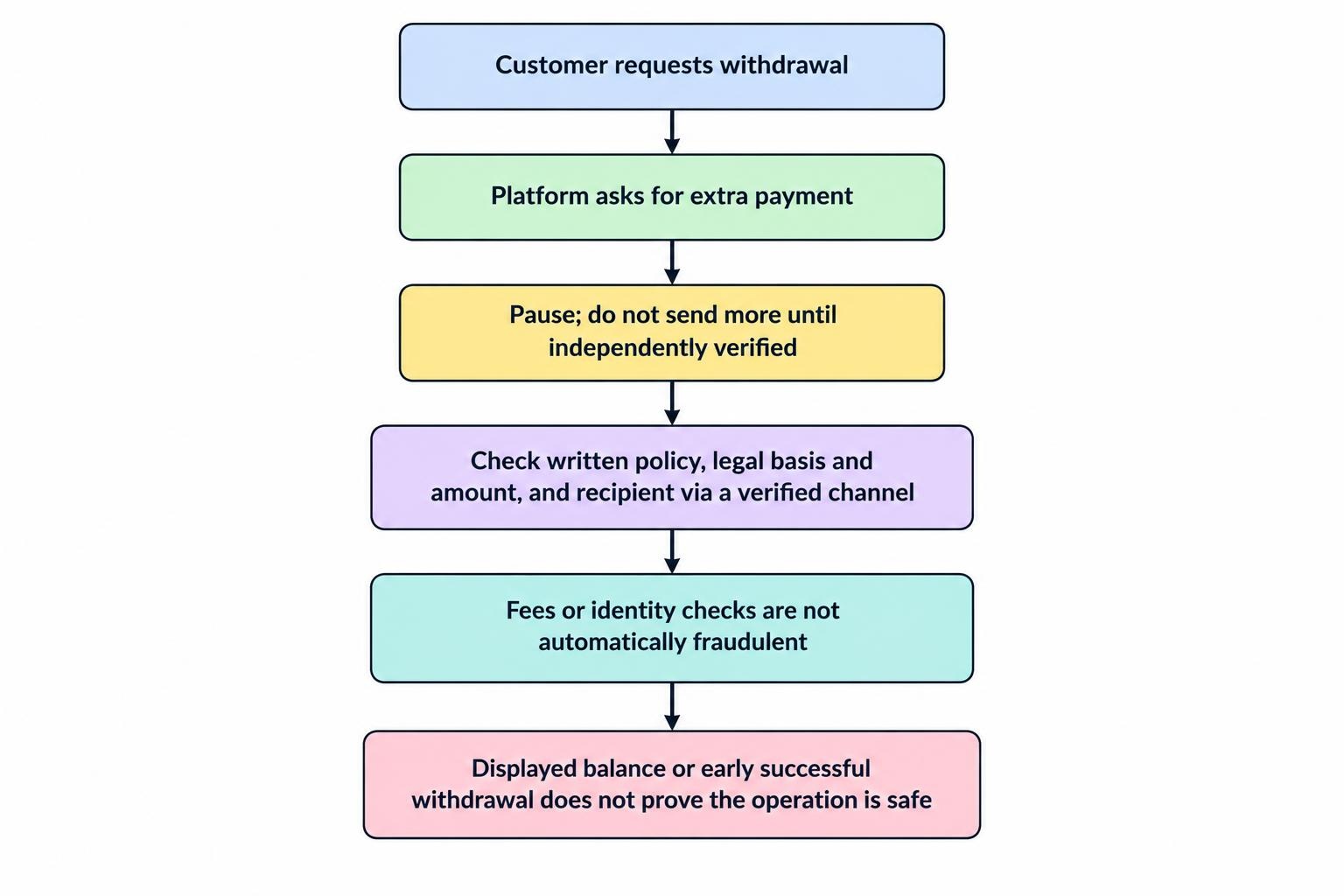
A common fraud pattern involves demanding a new deposit for taxes, insurance, verification or account release before an existing balance can be withdrawn. The CFTC’s warning about fee scams describes this sequence in forex and cryptocurrency schemes.
Consider a hypothetical account showing $24,000 after an $8,000 deposit. A demand for another $3,000 to release the balance creates a decision about a new $3,000 payment. The displayed $24,000 should not be treated as independently verified money when assessing that decision.
Tax obligations can exist, but a platform’s demand is not proof of a tax liability. Verify the legal basis, amount and recipient independently. A purported tax payment to an employee’s wallet or an unrelated beneficiary is especially concerning.
The SEC’s explanation of advance fee fraud describes demands for upfront payments framed as taxes, commissions or validation charges. Paying can lead to another invented requirement.
Understand the limits of a withdrawal test
After the provider’s identity and permissions have been checked, a small deposit and withdrawal can test administration. It can reveal unexpected charges, unclear instructions or poor processing.
It cannot establish that the operation is safe. The CFTC’s advisory on relationship based forex scams warns that fraudsters may permit an early withdrawal to encourage a larger investment. Keep that limitation in view when deciding whether to increase funding.
Assess Trading Conditions and Execution Fairly
Understand how the broker charges
Compare the complete cost of the account, including spreads, commissions, financing and conversion charges. A narrow advertised spread can coexist with substantial costs elsewhere.
Take a hypothetical EUR/USD position of 10,000 euros. A one pip movement is approximately $1. A one pip spread therefore represents roughly $1 for an immediate round trip at unchanged market prices, before commission. The same cost repeated frequently can materially affect a small trading account.
An expensive account is not necessarily fraudulent. The relevant questions are whether the charges were disclosed, whether they are applied consistently and whether the service represents acceptable value for the strategy.
Financing deserves separate review for positions held overnight. Save the applicable schedule and compare it with actual adjustments. If a charge cannot be reconciled, request an explanation using the trade reference and dates.
Investigate execution with records
For a disputed fill, record the order type, submission time, requested price, executed price and position size. Include the platform’s timezone. Without those details, comparisons with other charts can be misleading.
Prices shown by different providers may differ, and a chart may display a bid price while the transaction depends on an ask price. Those details need to be resolved before concluding that a stop was triggered incorrectly.
There can nevertheless be abusive execution practices. In its notice on forex transaction requirements, NFA discusses cases involving asymmetric slippage settings that favoured the dealer at the customer’s expense. The notice concerns NFA Forex Dealer Members, but illustrates why patterns and execution records matter.
Review favourable and adverse execution across a meaningful sample. One problematic trade may justify a complaint, while repeated unexplained treatment can support a broader investigation. Keep the original export files rather than relying entirely on screenshots.
Terms such as ECN, STP and no dealing desk should also be examined through the agreement and execution policy. A marketing label does not establish the counterparty arrangement or resolve how orders are handled.
Likewise, a recognisable trading application does not authenticate the company connected to it. The CFTC’s social media fraud guidance warns that polished websites and applications can support operations that never conduct the promised trading.
Protect Access to Accounts and Devices
Broker fraud can involve obtaining access to other financial accounts as well as taking the initial deposit. Treat assistance with installation, funding or withdrawals as a separate security question.
The FCA’s warning about screen sharing scams explains how fraudsters use legitimate remote access software to reach personal information and financial accounts. The software’s reputation does not establish that the person requesting access is genuine.
Do not allow a sales representative to control your device while you access banking or payment services. End any session that moves beyond an agreed support task into passwords, payment authorisation or unrelated accounts.
Keep brokerage, email and banking credentials separate. Email deserves particular attention because it may receive password resets and withdrawal confirmations. Use the strongest authentication options available and retain recovery information securely.
Authentication codes should only be entered into a verified service for an action you initiated. A caller asking you to read out a code may be attempting to approve a transaction or access an account.
The SEC’s guidance on identity theft and investment accounts describes impersonation websites that steal login details and authentication codes. Access the client portal through a verified bookmark instead of a link supplied in an unexpected message.
If automation requires API access, understand the permissions being granted. Trading access and withdrawal access create different exposures. Grant only what the service needs and establish how access can be revoked.
A wallet recovery phrase or private key is especially sensitive. It should never be supplied to someone claiming it is needed to verify a broker withdrawal or recover lost trading funds.
What to Do if You Suspect a Forex Broker Scam
Stop further payments and contact the payment provider
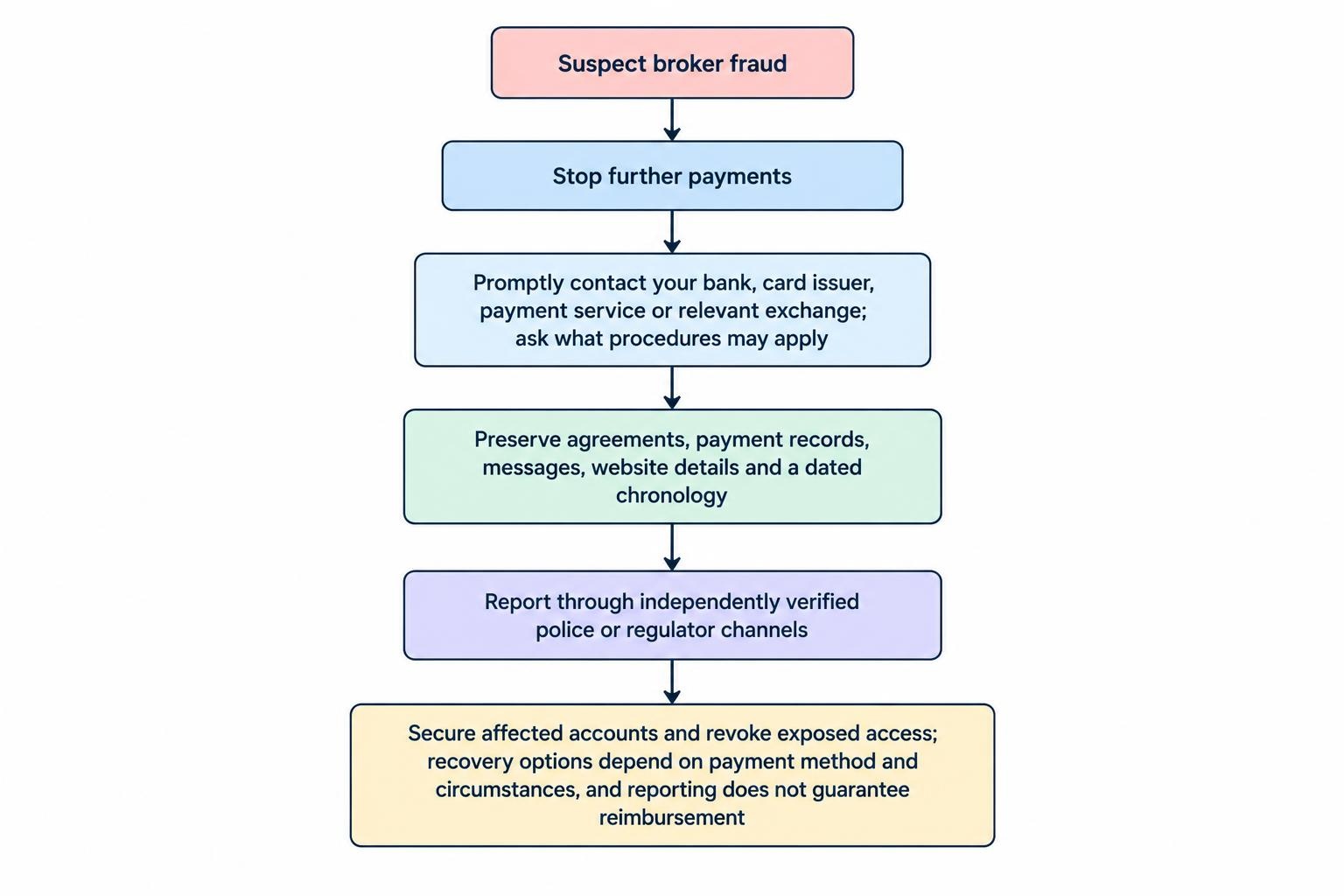
Stop sending additional money while the situation is investigated. A demand for one final deposit should not determine the response. Repeated payments can increase the loss without changing the prospects of withdrawal.
Contact the bank, card issuer or payment service used for the transfer promptly. Explain that you suspect investment fraud and provide the transaction details. Ask what recall, dispute, reimbursement or account protection procedures may apply.
The FTC’s guidance for people who have paid scammers recommends contacting the relevant payment provider immediately. Available remedies depend on the payment method, jurisdiction and circumstances; reporting does not guarantee reimbursement.
Describe the payment accurately. If you authorised a transfer after being deceived, say that. Distinguish it from a transaction made without your permission so the provider can assess the correct process.
For cryptocurrency payments, notify the exchange or service used and provide the transaction identifier and recipient address. Ask what action is possible. A recorded blockchain transaction can support an investigation, but does not by itself create a reversal mechanism.
Preserve a usable evidence file
Save the agreement, account statements, deposit confirmations and withdrawal requests. Preserve messages showing promised returns, changing explanations or demands for additional payments.
Record the website address and the names used by the company and its representatives. Include email addresses, telephone numbers, beneficiary details and relevant dates. Keep the original files where possible.
Prepare a short chronology that connects each contact with the resulting payment or account event. An investigator should be able to distinguish what you personally observed from what the operator claimed.
Separate actual transfers from the profits displayed on the platform. If $8,000 was deposited and the dashboard later showed $24,000, both figures matter, but they represent different kinds of evidence.
Preserve records already available without continuing risky engagement. Do not make another payment to obtain a statement, prove a withdrawal problem or persuade the operator to admit misconduct.
Report through verified official channels
Report suspected fraud to the appropriate police or cybercrime authority and the relevant financial regulator. Find those channels independently, since a fraudster may supply a fake regulator contact as part of the scheme.
In Kenya, the CMA complaints page provides complaint routes and information about the Capital Markets Fraud Investigation Unit. In the United States, NFA’s investor page explains complaints and arbitration involving its members. The correct route depends on the entity and the activity.
A service dispute with an identifiable regulated broker may also require its formal complaints procedure. State the facts, the disputed amount and the remedy requested. Keep the response and check any escalation deadlines with the relevant authority.
Secure affected accounts and avoid recovery fraud
If credentials or device access were exposed, contact affected financial institutions immediately. From a trusted device, change compromised passwords and revoke unknown sessions or permissions. Address the email account used for financial services as part of that process.
Expect possible follow-up approaches from people offering to recover the money. Knowledge of the original loss does not establish legitimacy; details may have been shared or obtained from public complaints.
The SEC’s resources for fraud victims warn about recovery scams involving upfront fees, impersonated authorities and requests for private keys. Verify any professional independently and obtain a clear description of the work and charges. Guaranteed recovery claims deserve the same scrutiny as guaranteed trading profits.
Continue Checking the Broker After Account Opening
Verification should be repeated when the account arrangement changes. A request to transfer the account to another group company creates a new set of questions about the contract, regulator and complaint process.
Treat changes to deposit instructions with particular care. Confirm them through a previously verified channel before sending money. A message that appears to come from a familiar representative can still result from impersonation or a compromised account.
Review statements regularly and reconcile them with your own bank records. The opening balance, deposits, withdrawals, trading results and charges should provide a coherent explanation of the closing balance. Investigate differences while the supporting records remain accessible.
Keep dated copies of material terms. If a dispute concerns a withdrawal restriction or charge, the version accepted when the account opened may be relevant. A current webpage may not show what was previously disclosed.
The broker’s regulatory status also needs periodic checking. Save notices concerning restrictions, disciplinary action or changes to permitted activity. Read what the notice actually says before drawing conclusions about its effect on your account.
Maintain a separate limit for the money held with the provider. That limit should reflect trading requirements and the exposure you are prepared to accept, rather than repeated encouragement from an account manager.
When an explanation remains inconsistent with the agreement or independent records, pause new funding while it is resolved. Record the question, the supporting evidence and the provider’s written answer. Resume only when the information is sufficient to make an informed decision about the account.